
A go-to-market (GTM) strategy is the plan for bringing one specific product or offer into one specific market. Marketing is the ongoing work of building your brand and demand across the whole company. GTM has a start, a target and a finish line. Marketing keeps running after the launch is over. You need both, and the order in which you build them decides whether a launch lands or stalls.
TL;DR
- GTM is a launch plan. It is time-bound and tied to a product or a market. Marketing is continuous and company-wide.
- Marketing is one input into GTM. GTM also covers pricing, sales motion, channels, partners and customer support.
- Product marketing sits between the two. It writes the story (positioning, messaging) that GTM then delivers at scale.
- In a new country, GTM comes first, and it must be local. Home-market assumptions are a leading cause of delayed launches.
- Brand identity is the foundation for both. Without a clear brand, neither plan has anything consistent to say.
Table of Contents
- The short answer: a plan versus a practice
- Go-to-market vs. marketing side by side
- What a GTM strategy actually contains
- What a marketing strategy contains
- Where product marketing fits
- Which one do you need first?
- Entering a new market: GTM must be local, and branded
- Our perspective: define the brand before you promote it
- How we help with launches and market entry
- A practical checklist before you launch
- FAQ
- Sources
The short answer: a plan versus a practice
The cleanest way to separate the two is by time and scope.
Stripe describes a GTM strategy as a comprehensive plan for launching a product or service. It lays out how a business will connect with customers and gain a competitive edge. It is usually run as a project over months, not years.
Marketing is wider and longer. The American Marketing Association’s guidance on marketing versus promotion frames marketing as the long game: building brand value and nurturing customer relationships over time. It evolves as the company and its customers change.
So think of it like this:
- Marketing answers: who are we to our customers, and how do we stay relevant to them?
- GTM answers: how do we get this offer in front of this audience, sold and supported, in the next few months?
Go-to-market vs. marketing side by side
| Dimension | Go-to-market strategy | Marketing strategy |
|---|---|---|
| Scope | One product, service or market entry | The whole company and brand |
| Timeline | Defined window, often a few months up to a year | Continuous and long-term |
| Main goal | Market entry, first traction, early revenue | Awareness, demand, retention, brand equity |
| Who is involved | Product, sales, marketing, customer support, often finance and legal | Mainly the marketing team, with input from sales and product |
| Typical content | Target segment, value proposition, pricing, channels, sales motion, launch milestones | Brand, messaging, content, campaigns, the marketing mix |
| Success looks like | A launch that hits agreed milestones | Steady growth in brand value and customer relationships |
The timeline and goal rows follow how Stripe and the AMA describe the two. The Aha! comparison makes the same split: marketing strategy is long-term and company-driven, GTM is short-term and product-driven.
Why the confusion exists
In an early-stage company the two often look identical. The only thing to market is the first product, so the marketing plan is the launch plan. Aha! notes that in early-stage companies the two can be one and the same, while at more mature companies they involve different teams with different goals.
That is why founders ask the question at all. The terms blur when you are small, then split as you add products, segments and countries.
What a GTM strategy actually contains
Marketing is one chapter of a GTM plan, not the whole book. A working plan answers these questions:
- Who is the buyer? A narrow segment, not “everyone in the market.”
- What is the offer and the value proposition? Why this buyer should switch or start.
- What is the price and the commercial model? Including discounts, contracts and local payment habits.
- How will it be sold? Direct sales, self-serve online, distributors, resellers or a mix.
- Which channels reach the buyer? Search, events, social, retail, partners.
- How will you support customers after the sale? Onboarding, service, returns, language.
- What counts as success? Milestones and thresholds set before launch, with a review date.
Notice that only items 4 and 5 are partly marketing. The rest need decisions from sales, product, finance and operations. That cross-functional reach is the real difference. A marketing plan can be written by one department. A GTM plan cannot.
What a marketing strategy contains
Marketing strategy is about the standing relationship between your brand and your audience. It typically covers:
- Brand and positioning: what you stand for and how you differ.
- Audience understanding: segments, needs, behavior.
- The marketing mix: product, price, place and promotion, managed continuously.
- Content and campaigns: the day-to-day programs that build awareness and demand.
- Measurement: brand health, pipeline, retention.
The AMA’s definition of marketing is broad on purpose: creating, communicating, delivering and exchanging offerings that have value for customers, clients, partners and society. Launching is one moment inside that larger activity.
Where product marketing fits
The second query readers bring to this topic is GTM versus product marketing. The relationship is simple once you see the layers.
- Product marketing creates the narrative: positioning, messaging and the value proposition for a product.
- GTM is the structured blueprint that delivers that narrative: distribution, sales funnel, pricing and cross-team timing.
One SaaS-focused analysis puts it this way: product marketing is an essential part of GTM, and launches commonly fail when teams work in silos. We agree with the practical point. A strong story with no distribution plan goes nowhere. A distribution plan with a weak story sells at a discount.
A quick test: if the question is “what do we say and why does it matter?”, you are in product marketing. If it is “who sells it, where, at what price, and by when?”, you are in GTM.
Which one do you need first?
It depends on your situation.
You are launching a new product in your home market. Write the GTM plan first, then hand its messaging and channel decisions to the marketing team to run as ongoing programs.
You have an established product and want steady growth. You need marketing strategy. A launch plan will not help you here, because there is nothing to launch.
You are a startup with one product. Write one document, but label the launch milestones separately from the brand work. You will split them later.
You are entering a new country. This is the case where the distinction matters most, and it gets its own section below.
Entering a new market: GTM must be local, and branded
A GTM plan that worked at home rarely transfers whole. Two points from research are worth taking seriously.
Local fundamentals decide the outcome
McKinsey’s analysis of first-time international launches in biotech names a deep, country-specific strategy as one of the most critical success factors. It warns against assuming that home-market norms will hold in new territories. The sector differs from yours, but the lesson travels: pricing, buying habits and regulation shift by country.
The same piece shows that structural barriers, such as procurement rules, tax exposure and local approvals, can determine whether entry is viable more than the commercial opportunity does. Check feasibility before you spend on creative.
Think in regions and cities, not whole countries
McKinsey’s work on reaching Asian consumers argues for a regional-and-local mindset: give local operations room to tailor product and price to urban clusters rather than imposing one national plan. The article is from 2009 and about Asia, so treat it as a principle, not a playbook for your market. It still fits: Madrid, Barcelona and Valencia are different audiences inside one country.
Do not over-commit early
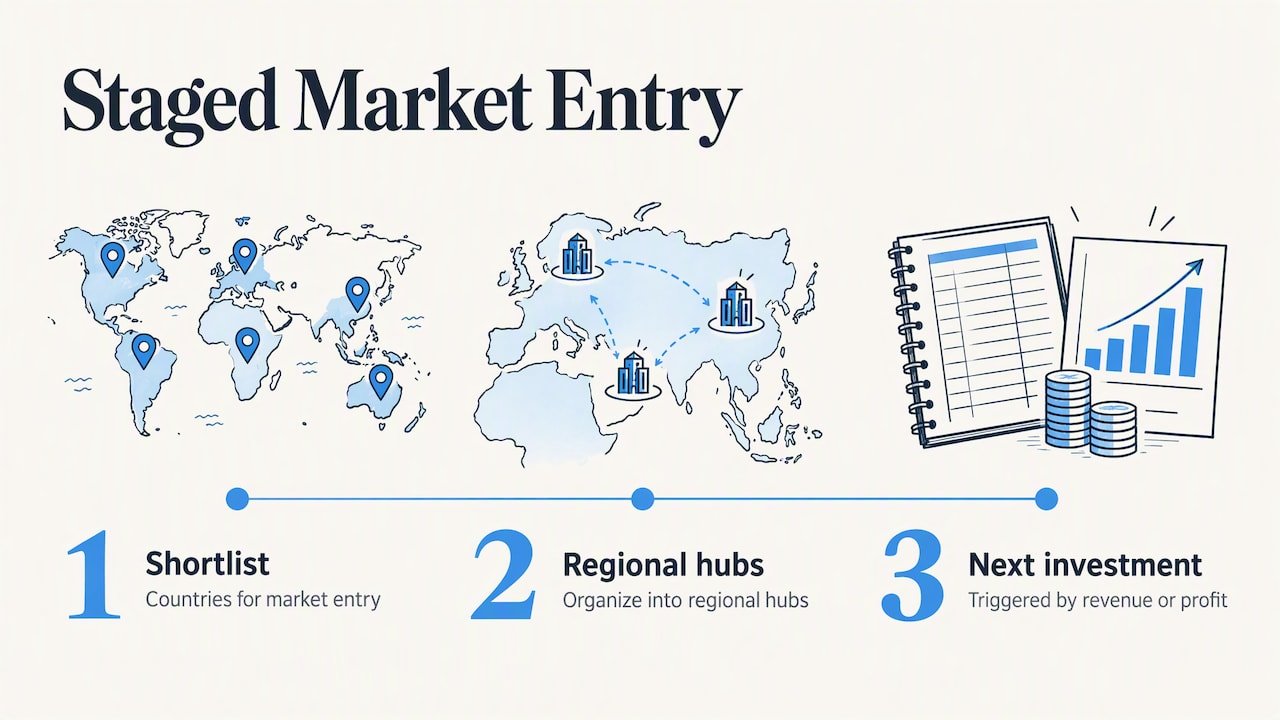
McKinsey also describes a common failure: building a full local commercial organization before hitting key milestones. The more sustainable path is a short list of countries, regional hubs and predefined revenue or profit thresholds that trigger the next investment. That is GTM thinking: bounded, staged, measurable.
Use local intermediaries where they help
A UK government report on digital trade notes that intermediaries help smaller exporters manage linguistic, cultural and procedural complexity. In many markets, local distributors or agents are a necessity for dealing with regulation and compliance. Your GTM plan should say who plays that role in each country.
Then build the brand layer
This is where marketing re-enters. Once the entry plan is set, the audience has to recognize, trust and remember you in their own language and cultural context. That means adapting the name, tone, visuals and proof points, not just translating copy. We cover this for one market in our guide to Spanish market localization and in our piece on Spain’s culturally specific brand language.
Our perspective: define the brand before you promote it
We work with companies that are crossing borders, from our bases in Barcelona and Copenhagen. The pattern we see is that teams argue about GTM versus marketing when the real gap sits one step earlier: the brand has not been defined for the new audience.
A GTM plan tells you where and when. A marketing plan tells you how often and through which channels. Neither tells you who you are to a buyer in a country that has never heard of you. If that answer is vague, every channel amplifies the vagueness.
So we suggest this order for a market entry:
- Brand and identity for the new market. Decide what stays global and what adapts locally.
- GTM plan. Segment, offer, pricing, channels, milestones.
- Launch assets. Digital presence, campaigns, sales materials, and where relevant an online store or a prototype.
- Ongoing marketing. Take over once the launch window closes and learn from early results.
We make the same argument from a different angle in Branding Before Marketing, written about destinations that promote themselves before defining themselves. It applies equally to companies. And it is the idea behind Building Bridges: connecting a brand to people who do not share its home context.
— Jacob
How we help with launches and market entry
If you are planning a launch or a move into a new country, we can help with the parts that connect strategy to what the market sees:
- Brand & Identity: a market-ready identity and strategy.
- Digital Presence & Campaigns: the channels and campaigns that carry the launch.
- E-Commerce: online stores built for the market you are entering.
- Prototype Creation & Delivery and Sales & Presentation: tangible materials for buyers, partners and events.
We also work on Spanish market entry, startup launches and exports to the UK and Nordics. See all our services or look at our branding and strategy projects. Ready to talk? Start a conversation.
A practical checklist before you launch
Use this to test whether your plan is a GTM plan, a marketing plan, or a blend that needs splitting.
- Is there an end date or review date? If yes, it is GTM. If not, it is marketing.
- Does it name an owner in sales, product and support, not just marketing? GTM needs all of them.
- Is the segment narrow enough to name ten real target customers? If not, narrow it.
- Are there milestones that trigger the next investment? Set them before you spend.
- Is the brand story the same in every channel? If not, fix positioning first.
- For a new country: has someone local reviewed the offer, price and message? Do this before launch, not after.
- What happens on day 91, or day 366? Decide which ongoing marketing programs take over.
FAQ
What is the difference between go-to-market and marketing?
Go-to-market is a time-bound plan to launch a specific product or enter a specific market, and it involves sales, product and support as well as marketing. Marketing is the continuous, company-wide effort to build brand value and customer relationships. GTM often ends in a handover to marketing once the launch phase is over.
Is product marketing the same as a GTM strategy?
No. Product marketing shapes the positioning, messaging and value proposition for a product. GTM is the broader plan that delivers it, covering pricing, channels, sales motion and timing. They work best together, and launches tend to suffer when they are run separately.
Is a GTM strategy part of a marketing strategy?
It can be either way, depending on company size. In a startup with one product, the two are often the same document. In larger companies, the GTM plan is a project that draws on the marketing strategy and also on sales, product and operations.
How long does a go-to-market plan last?
It is usually defined by the launch window, commonly a few months and up to a year, according to Stripe. Set review points and revenue or traction thresholds in advance. After that, ongoing marketing takes over.
Do I need a different GTM plan for each country?
Yes, in practice. Regulation, pricing, buying behavior and culture differ by market, and McKinsey warns against assuming home-market norms will hold. You can reuse your core positioning and adapt the rest locally.
Sources
- What is a go-to-market strategy? A quick GTM guide (Stripe)
- Marketing vs. Promotion: Key Differences and How They Impact Your Strategy (AMA)
- What is Marketing? The Definition of Marketing (AMA)
- Marketing strategy vs. go-to-market strategy (Aha!)
- Product Marketing vs GTM Strategy: How SaaS Teams Drive Growth
- Building a global biotech: Taking a first-time launch into international markets (McKinsey)
- Think regionally, act locally: Four steps to reaching the Asian consumer (McKinsey)
- Unlocking Digital Trade (UK government)