
A brand perception survey is a structured questionnaire that shows how a defined audience thinks and feels about your brand: what they associate with it, how far they trust it and how it compares with the alternatives. The method is simple. Choose the audience first, ask a short set of neutral questions, analyse by segment and repeat on a steady schedule. This guide covers each step, with extra advice for brands entering a new market.
TL;DR
- Decide what the survey must help you decide before you write any questions. Everything else follows from that.
- Survey the people you want to win, not only your customers. Customers alone tend to tell you the brand is good.
- Keep it to roughly 10 to 12 minutes at most, with a mix of rating scales and open text.
- In a new market, adapt the survey instead of just translating it, and validate it locally.
- Report by segment, separate awareness problems from perception problems, and repeat at a consistent interval.
Table of Contents
- What a brand perception survey measures
- Who to survey
- The questions to ask
- How to run the survey, step by step
- Running a brand image survey in a new market
- How to analyse the results
- When to repeat the survey
- From findings to brand decisions
- Our perspective
- Turn survey findings into a market-ready brand
- FAQ
- Sources
What a brand perception survey measures
A brand perception survey measures the beliefs, feelings and associations people hold about a brand. It asks customers, prospects and sometimes employees to describe the brand, rate it and compare it with competitors.
In practice, a good study covers a handful of dimensions:
- Awareness: do people recall the brand unprompted?
- Associations: which descriptors come up most often?
- Sentiment and favourability: is the overall feeling positive or negative?
- Trust and quality: how credible does the brand seem?
- Competitive position: who is preferred, and why?
- Loyalty: would people recommend you?
Those six dimensions appear in QuestionPro’s breakdown. Other guides go further. Sogolytics lists constructs such as emotional response, relevance and fit, differentiation, information sources and unaided description.
Trust deserves particular attention. The Edelman Trust Barometer special report, a 14-market survey of 14,000 people fielded in 2021, found that 88% rated trust as critical or important when deciding which brands to buy or use. Maze notes that trust moves more slowly than awareness and is harder to rebuild once it falls, which makes it a useful early indicator to watch.
What the results help you decide
Qualtrics describes three outcomes: understanding how campaigns affect perception, closing the gap between the qualities you want to project and how customers actually feel, and finding areas to improve. A useful survey ends in a decision, such as a repositioned message, a refreshed identity or a different channel mix.
Brand perception and brand awareness are not the same thing. Sogolytics points out that high awareness with weak perception is a positioning problem, and more advertising will make it worse. Knowing which problem you have saves budget.
Who to survey
Sampling matters more than question wording. Sogolytics makes the case that customers alone will say your brand is good, while prospects, lapsed buyers and category non-users are where the actionable findings live.
A sound sample usually includes:
- Current customers, for satisfaction, loyalty and usage.
- Lapsed customers, for switching reasons and decline.
- Non-customers who fit your target profile, for awareness and consideration.
- Employees, only if you are studying the internal view of the brand.
Quali-Fi advises surveying the whole target audience and weighting the sample to reflect the real market. Speero adds that existing customers already know you, which inflates awareness and skews perception towards the product experience.
For B2B brands, define roles, company sizes, sectors and markets precisely. Forrester’s Ian Bruce says an explicit understanding of the audience is a critical first step, and that a survey can cover all buyers or only buyers of one offering, vertical or sub-brand. If you are still deciding which groups to prioritise, creating audience-centric content starts from the same discipline of knowing exactly who you are speaking to.
The questions to ask
Qualtrics suggests organising questions around four areas, which it ties to brand affinity: cognitive, emotional, language and action. Here is a practical set built on that framework and on the sample questions published by Attest.
| Area | Example question | Format |
|---|---|---|
| Awareness | Which brands come to mind when you think of [category]? | Open text, unaided |
| Cognitive | When you think of [brand], what comes to mind first? | Open text |
| Emotional | What feelings do you experience when you think about [brand]? | Open text or emotion list |
| Language | Which three words would you use to describe [brand]? | Open text or word list |
| Audience fit | Who do you think [brand] is for? | Open text |
| Competitive | How does [brand] compare with other options you know? | Rating grid |
| Trust | How much do you trust [brand]? | 1 to 5 scale |
| Action | How likely are you to recommend [brand] to a friend or colleague? | 0 to 10 scale |
The trust and recommendation items are the ones to standardise first. If you are weighing rating-scale styles, a comparison of choosing a survey method shows how different scales behave when you measure trust and emotion.
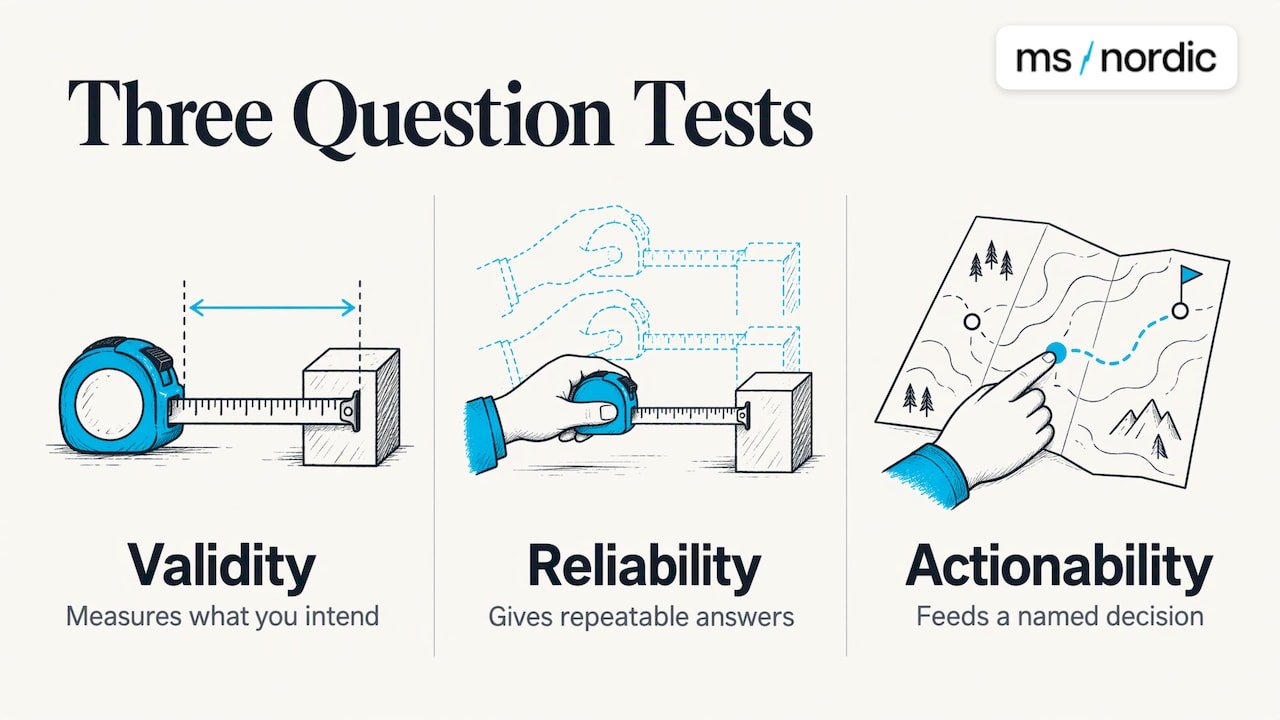
Three tests for every question
Forrester says good questions need three attributes: validity, reliability and actionability. In plain terms, each question must measure what you think it measures, give repeatable answers and feed a decision. If you cannot name the decision a question serves, cut it.
Keep it short and neutral
Attest’s Elliot Barnard recommends 10 to 12 questions, no more than five minutes, a mix of quantitative and qualitative items, “don’t know” options and a test outside your team before launch. Vanson & Bourne puts the ceiling for good data quality at around 12 minutes, after which fatigue degrades answers.
Write neutrally. Ask “How would you describe our service?”, never “How excellent was our service?”. Put open-text questions before prompted lists, so the lists do not colour what people say unaided.
How to run the survey, step by step
- Write down the decision. For example: “Should we reposition against local competitors?” Sogolytics advises stating the decision the study will inform before anything else.
- Define each audience separately. Quotas and questions may differ by group.
- Build the attribute list from real language. Use words customers and prospects actually use in interviews and reviews, not internal marketing terms.
- Set the sample size. QuestionPro suggests at least 300 to 400 completes per segment, with a margin of error of about ±4.9% at 400 responses and ±3.1% at 1,000, at 95% confidence.
- Pilot it. Guides range from 20 to 30 people up to 50 to 100 for larger studies. Fix confusing wording and timing before the full launch.
- Field it in a short window. One to three weeks is the range the guides give, so that external events do not distort answers.
- Analyse, report and assign actions. A finding without an owner rarely changes anything.
B2B samples are harder to fill. Sapio Research describes 1,000 responses as very good for a B2B market, 500 as good and fewer than 250 as small enough to make tracking over time difficult. If your buyers are a narrow group of senior decision makers, plan the recruitment early.
Running a brand image survey in a new market
A survey that works in your home market will not automatically work in another. The Logit Group is clear that translating is not adapting: scales, question framing and mobile rendering need validating market by market, or bias enters from the first wave.
The cross-country evidence points the same way. A peer-reviewed study in the Journal of Marketing, using data from seven countries including Spain, found that brands act as signals across countries, but that the effect of credibility on choice was stronger for consumers who rate high on collectivism or uncertainty avoidance. The same brand signal can carry different weight in different places.
A practical approach for multi-market work:
- One objective, shared everywhere. Attest’s Nicholas White advises a single global research objective, standardised key questions and scales, and localised competitor names, examples and prices in local currency.
- Translate and back-translate. mTab recommends one translator for the local version, a second who has not seen the original to translate it back, then a pilot with local respondents.
- Build local brand lists. Keep core brands everywhere for comparison and add local competitors. Use simple labelled scales without idioms, and fix your definitions of awareness, consideration and preference once.
- Add qualitative work. Interviews surface cultural drivers, emotional triggers and unspoken needs that a survey cannot capture, and they guide how to adapt messaging, packaging and pricing perception without losing consistency.
If your next market is Spain, our guides on Spanish market localisation and brand localization show what to adapt before you ask local audiences anything.
How to analyse the results
Resist the urge to read the overall average first. Sogolytics recommends this order, which we find sensible:
- Check the sample against your quotas.
- Report by segment before totals.
- Run driver analysis to see which attributes move favourability most.
- Build a perceptual map on the two strongest drivers.
- Measure the gap between intended and actual positioning.
- Code open-text answers into themes.
- Separate perception problems from awareness problems before assigning them.
Then cross-check against other data. Vanson & Bourne recommends triangulating brand metrics with customer experience, operational or financial data, so that one survey never carries a strategic decision alone.
When to repeat the survey
One survey is a snapshot. The value grows when you repeat it on the same terms. Quantilope stresses that a consistent cadence for each wave is one of the most important factors, because you need consistency to make fair claims about trends.
How often depends on how fast your market moves:
- B2B with long sales cycles: Adience suggests waiting 12 to 18 months, or 3 to 6 months after several large campaigns or a market disruption. Sapio Research recommends once a year.
- Faster consumer markets: quarterly or twice-yearly waves are common.
Keep around 80% of questions identical between waves and use a rotating module for new topics, as Adience advises. Changing the core wording breaks the comparison.
From findings to brand decisions
Survey results only matter when they change something. Ipsos describes a six-market segmentation and positioning study for a nail-care brand that led to changes in positioning, visual identity, media planning and the innovation pipeline. A fashion research programme across the US, UK, Japan and South Korea showed that a global brand holds several local reputations at different stages of maturity.
The lesson for an expanding brand is practical. Match each finding to a lever:
- Low awareness among the right audience: a campaign and channel question.
- Awareness without trust: a proof, credibility and messaging question.
- Wrong associations: a positioning and identity question.
- Strong at home, weak locally: a localisation question.
Our perspective
Most brands we meet at the start of an expansion ask for a new logo or a translated website. The survey usually shows the real issue sits one layer deeper: the brand means something different to the people in the new market than it does at home.
Working from Barcelona and Copenhagen, we see that gap often. A message that feels clear and modern in one language can read flat, formal or simply foreign in another. That is why we pair strategic insight with cultural fluency, and why we treat perception research as the first step of market entry, not an afterthought.
Our advice: ask the people you want to win, in their own language and with their own competitors in the frame. Then let the answers shape identity, tone and campaigns together. Building bridges between a brand and a new audience starts with listening.
Jacob Munch
Turn survey findings into a market-ready brand
If your results show a gap between how you want to be seen and how a new audience sees you, we can help close it. We work on brand and identity, localisation, digital presence and campaigns for companies entering new markets, including Danish companies exporting to Spain and brands heading to the UK and the Nordics.
Tell us what the research showed and what you need to change. Start a conversation about the right package for your market.
FAQ
How many questions should a brand perception survey have?
Aim for 10 to 12 questions that take no more than about five minutes, as Attest recommends. Longer brand trackers exist, but each question should serve a named decision. Cut anything you cannot connect to an action.
Should I only survey my existing customers?
No. Customers already know you, which inflates awareness and skews results towards product experience. Include prospects who fit your target profile and, where relevant, lapsed customers. Weight the sample to reflect the real market.
What is the difference between brand awareness and brand perception?
Awareness is whether people know the brand exists. Perception is what they believe and feel about it. The fixes differ: low awareness calls for visibility, while weak perception calls for positioning and messaging work.
How often should I repeat the survey?
For B2B brands with long sales cycles, once every 12 to 18 months is a common recommendation, or more often after major campaigns or market changes. Keep the core questions identical so waves can be compared. Pick a cadence you can sustain.
Can I use the same survey in another country?
Only after adapting it. Translate and back-translate, localise competitor names and examples, validate scales with local respondents and pilot first. Running an unvalidated instrument across markets introduces bias from the first wave.
Sources
- Brand Perception Surveys: Questions, Template & Steps (QuestionPro)
- Brand Perception Surveys: Meaning, Definition, Examples (Sogolytics)
- Trust: The New Brand Equity (Edelman Trust Barometer special report)
- Brand Perception Research: How Buyers See Your Brand (Maze)
- Brand Perception Surveys: The Complete Guide (Qualtrics)
- How to Set Up a Brand Tracking Study (Quali-Fi)
- Brand Perception Survey (Speero)
- Five Questions to Ask Before Building a Brand Survey (Forrester)
- 15 Brand Perception Survey Questions (Attest)
- A brief guide to brand research (Vanson & Bourne)
- Brand trackers: advice and good practice (Sapio Research)
- Managing Multi-Country Brand Tracking Studies (The Logit Group)
- Brands as Signals: A Cross-Country Validation Study (Journal of Marketing)
- How to run multi-market research effectively (Attest)
- Global Brand Tracking: A Multi-Country Guide (mTab)
- International Qualitative Research Guide (MindMarket)
- Brand Tracking in 2026: A Comprehensive Guide (Quantilope)
- How to Conduct B2B Brand Tracking Research (Adience)
- Segmentation case study (Ipsos)
- Case: Stone Island (BoF Insights)
- Creating Audience-Centric Content That Engages Readers
- Q12, eNPS, Likert or Trust Index: which survey method should you use?