
A brand refresh updates how your company looks and sounds while keeping its strategy, positioning and values. A rebrand changes the strategy itself: who you are for, what you stand for and how you are positioned. The test is simple. If the business has not changed but its expression has aged, refresh. If the business has changed, or is about to enter a market where the current story does not travel, rebrand. For companies expanding abroad, the answer often sits between the two: keep the core, adapt the rest. That is the work we do at MS Nordic, from Barcelona and Copenhagen.
TL;DR
- A refresh modernises the visible layer (logo, colours, typography, tone of voice) and leaves strategy and positioning intact.
- A rebrand rebuilds identity and strategy together, and is warranted when the current brand holds the business back.
- Expansion into a new country is a classic trigger, but it rarely needs a total overhaul: decide what must never change, then adapt everything else.
- Ask for objective evidence before committing to a rebrand. Vanity is the most expensive reason to start one.
- Plan the scope, budget and measurement before any design work begins.
Table of Contents
- What a brand refresh actually changes
- What a rebrand changes
- Refresh or rebrand: a side-by-side view
- When to rebrand: the signs that count
- Rebranding considerations before you commit
- Entering a new market: refresh, rebrand or adapt?
- A quick decision guide
- How we help
- Our perspective
- FAQ
- Sources
What a brand refresh actually changes
A refresh is a modernisation. HubSpot’s guide describes it as updating a brand’s image while maintaining its core identity and strategy. Typical changes include the logo, font, colour palette, slogan and writing style.
Think of it as a tune-up. Customers should still recognise you. Your promise, audience and market position stay where they are. What changes is the quality of the expression:
- A logo redrawn so it works on screens, in app icons and at small sizes
- A colour palette adjusted for accessibility and consistency across channels
- A refined tone of voice that matches how your customers now speak
- A redesigned website or sales deck that finally reflects the business you have become
A refresh suits a company whose strategy is sound but whose identity looks a decade behind. Our note on why the logo is only a small detail in a bigger picture makes the same point: a new mark on its own does not change how a market perceives you.
What a rebrand changes
A rebrand is a complete overhaul of identity and strategy. According to the same HubSpot guide, it is typically enacted when the current strategy is failing, and it touches positioning, values, brand guidelines and the mission and vision statements.
The visual identity changes too, but that is the consequence, not the cause. The cause is that the meaning has moved. The company may have entered a new category, outgrown its original story, merged with another business or acquired a different kind of customer. The old brand can no longer explain who you are.
A rebrand usually involves:
- Research into how customers, prospects and staff see the business
- A new or sharpened strategy: positioning, audience, proposition, values
- A new visual and verbal identity built on that strategy
- A rollout across every touchpoint, from product and packaging to email signatures
That is more work, more time and more internal change than a refresh. It is worth it when the old brand is the problem.
Refresh or rebrand: a side-by-side view
| Question | Brand refresh | Rebrand |
|---|---|---|
| What changes? | Visual and verbal expression | Strategy, positioning and identity |
| What stays? | Core identity, strategy, values | Often only the company itself |
| Typical trigger | Look and tone feel dated | Business, audience or market has changed |
| Risk to existing recognition | Low | Higher, needs careful transition |
| Internal involvement | Marketing and design | Leadership, sales, product, HR |
| Best for | Sound strategy, tired expression | Strategy that no longer fits the business |
When to rebrand: the signs that count
Start with the business, not the logo. A rebrand is justified by a change in what the company is or where it is going. HubSpot lists several cues: plans to expand nationally or internationally, a brand that restricts growth into other markets, negative customer associations and mergers or acquisitions.
Put those into practical questions:
- Has the offer changed? If you now sell something materially different from what the brand describes, the brand is misleading people.
- Has the customer changed? A move from consumers to enterprise buyers, or from a local base to several countries, changes what trust looks like.
- Is the reputation the obstacle? If customers hold negative associations with the name or the promise, a new coat of paint will not shift them.
- Have two businesses become one? A merger needs a single story.
- Does the brand stop you entering a market? A name, a claim or a visual language that does not carry across borders is a structural problem.
If none of these apply and the only complaint is that the brand looks old, you are looking at a refresh.
Guard against the vanity rebrand
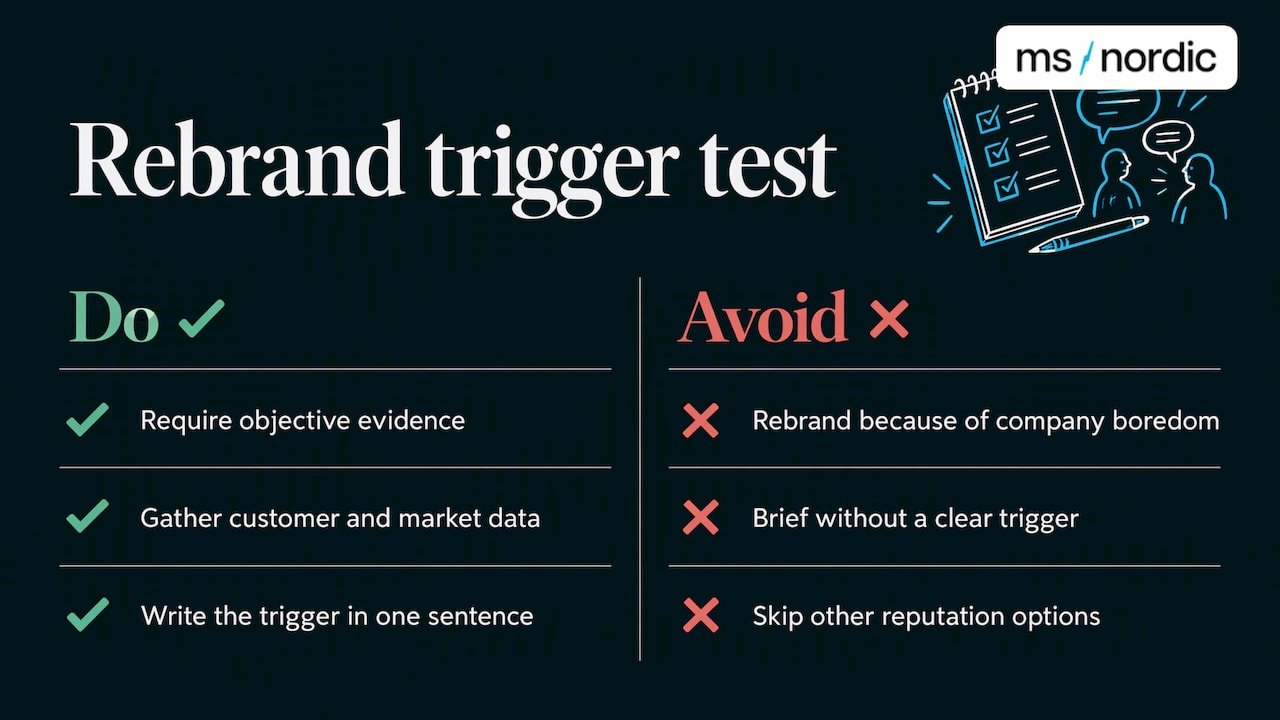
Rebrands are costly and disruptive, and boredom inside the company is not a reason. Forrester’s Brand Lifecycle Framework report states that corporate rebrands should be undertaken only after other options for improving brand reputation have been considered, and that marketing leaders should require objective evidence for rebrand triggers. Good evidence is concrete: customer interviews, lost-deal reasons, search and social data, a market-entry plan that the current brand cannot support.
Write the trigger down in one sentence before you brief anyone. If you cannot, you probably need a refresh, or nothing yet.
Rebranding considerations before you commit
Whichever route you choose, settle these points first.
1. What equity do you already hold?
Brand equity is the recognition and trust you have built. List what customers already associate with you and decide what is worth keeping: a name, a colour, a phrase, a reputation for reliability. A refresh protects this by design. A rebrand needs a deliberate plan to carry it over.
2. What problem are you solving, and for whom?
Name the audience whose behaviour you want to change: prospects in a new country, enterprise buyers, investors, recruits. The scope follows from that. A brand that has to win trust in a market where nobody knows you needs different work from one that has to look current to existing clients.
3. How big is the job, and what will it cost?
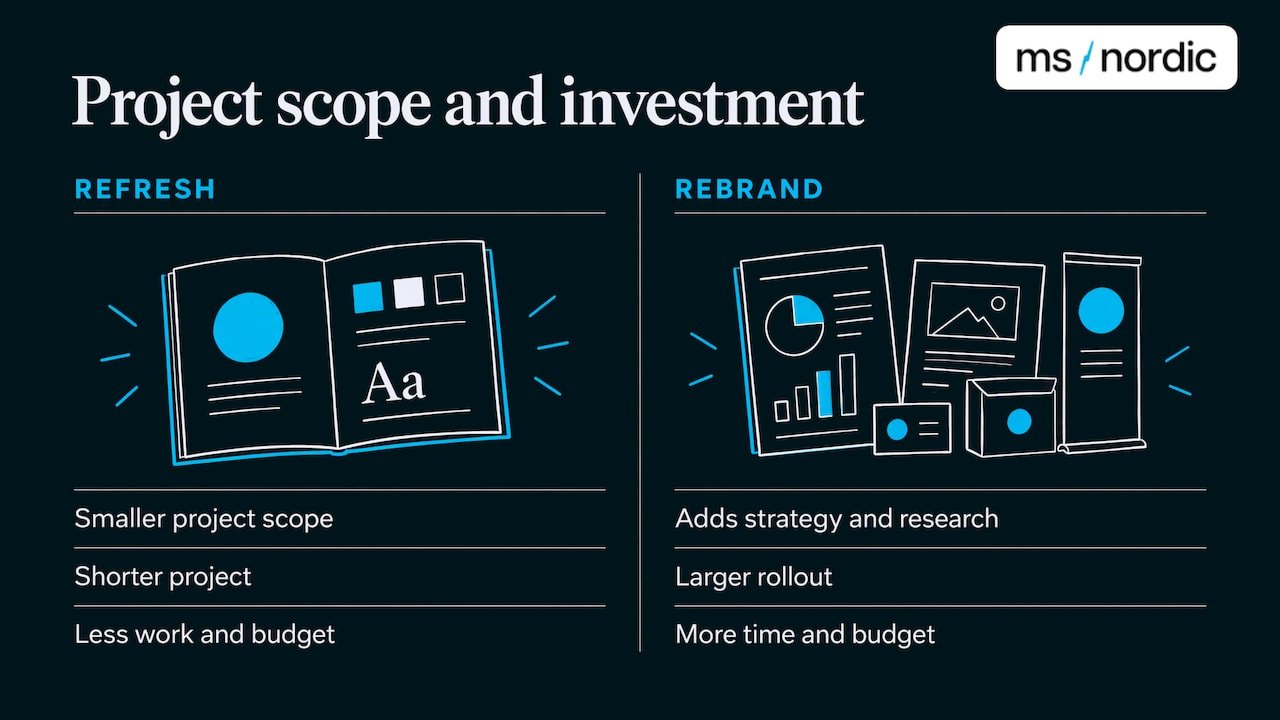
Scope drives budget. Published ranges vary widely by provider and region, and our own breakdown in what to budget for a rebrand and what drives the price explains the factors that move a quote: research depth, number of markets, volume of touchpoints, and digital build. A refresh is a smaller, shorter project. A rebrand adds strategy, research and a larger rollout, so it needs more time and a larger line in the plan.
Build in time for testing, corrections and legal processing such as trademark checks on any new name or mark, and give each phase its own timeline.
4. How will the rollout work?
List every place the brand appears before you start: website, e-commerce store, packaging, social profiles, sales decks, contracts, signage, event materials, email templates. Then decide what changes on launch day and what migrates in stages. Inconsistent rollouts confuse customers more than the change itself. This is where brand consistency across the whole business pays off: a clear set of guidelines gives every team the same reference point.
5. How will you know it worked?
Decide the measures before launch, not after. A workable set covers:
- Awareness: branded search volume, direct traffic, social mentions
- Perception: a short customer survey on the attributes you wanted to shift, run before and after
- Commercial results: enquiry quality, conversion rate, win rate, average deal size
- Digital performance: engagement and conversion on the pages that carry the new brand
Record a baseline for each in the months before you launch. Digital measures tend to move first. Perception and commercial results take longer, so review them over a year rather than a fortnight.
Entering a new market: refresh, rebrand or adapt?
This is the decision many of our clients face. A Danish company exporting to Spain, a startup preparing its first international launch or a brand moving into the UK all ask the same thing: does the brand we have still work there?
The research suggests a middle path. A Harvard Business School working paper by Gokhale and Lal argues that most international retail expansions fail before entry because of a missing “balanced adaptation”: work out what must never change, then adapt everything else. The paper illustrates this with IKEA’s entry into India, including its 30% local sourcing.
An earlier academic study of 33 exporters and 107 products found that culturally more distant markets required more changes, especially in packaging size and style, while culturally closer markets more often required brand-name changes. In other words, the amount of adaptation depends on how far apart the markets are, and the kind of adaptation differs too.
Translate that into a decision:
- Define the fixed core. Your values, promise and the qualities that make you recognisable. These stay.
- Test the expression in the target market. Name, tagline, imagery, colours, tone and proof points can carry different meanings abroad.
- Choose the lightest change that works. If only the expression fails, refresh or localise. If the positioning itself does not land, rebrand.
For a Danish brand entering Spain, that often means keeping the clean, understated Nordic character that gives you credibility, while adapting language, references and the way you present trust. Our guides on brand localisation for a new market, the difference between transcreation and translation and Spanish market localisation strategy go deeper on each step.
A quick decision guide
Answer these honestly:
- Has your offer, audience or ownership changed since the brand was built? If yes, lean towards a rebrand.
- Is the strategy right, and only the look or tone dated? Refresh.
- Does the brand work at home but need tuning for one new country? Localise, with a refresh of the elements that do not travel.
- Is the main driver a wish for something new, without evidence? Pause and gather the evidence first.
How we help
We are a creative agency working from Barcelona and Copenhagen, and we specialise in branding, design and e-commerce for businesses entering and growing in new markets. Our approach combines strategic insight, creative skills and cultural fluency, so the identity we build stays true to you and makes sense to the people in the market you are entering.
Whether you need a refresh of your identity, a full brand and strategy rebuild, or brand localisation ahead of a launch, our Brand & Identity service is the place to start. Start a conversation, and we will help you define what stays, what adapts and what needs rebuilding.
The same team can carry the identity into your digital presence and campaigns and your e-commerce store, so the new brand shows up consistently where customers meet it.
Our perspective
Most businesses ask us whether they need a new logo. The better question is what the market needs to understand about them that it does not understand today.
When a company enters a new country, the temptation is either to export the brand unchanged or to rebuild it from scratch. Both can be expensive. We prefer to start with strategy: what is the core that makes this company itself, and what has to be translated into the culture it is entering? Sometimes the answer is a focused refresh. Sometimes it is a full rebrand. Often it is localisation done properly, with cultural fluency in the room from the first workshop.
That is why we work between Barcelona and Copenhagen. Building bridges between markets is not a slogan for us, it is how we approach every identity, website and launch: strategy first, design second, and measurable outcomes throughout.
Jacob Munch
FAQ
What is the main difference between a brand refresh and a rebrand?
A refresh updates the look and voice of a brand while keeping its strategy and core identity. A rebrand changes the strategy as well: positioning, values, mission and the identity that expresses them. Refresh when the company is the same but its image has aged. Rebrand when the company has changed.
How do I know when to rebrand?
Look for a change in the business rather than in taste. Expansion into new markets, a brand that restricts growth, negative customer associations and mergers are the usual triggers. Back the decision with objective evidence, such as customer research and commercial data, before you start.
Does expanding into a new country mean I have to rebrand?
Not necessarily. Decide what must never change, then adapt the rest: language, imagery, tone and proof points. If your core positioning works in the new market, localisation and a targeted refresh are often enough. If it does not land, a rebrand is the right step.
How long does each take?
A refresh is a shorter project than a rebrand, which adds research, strategy and a wider rollout. Timelines depend on scope, number of markets and touchpoints, so agree a schedule for each phase at the outset, with room for testing and legal checks.
Sources
- HubSpot: Brand Refresh vs Rebrand
- Forrester: Brand Lifecycle Framework, rebranding triggers
- Harvard Business School working paper 26-075: Retail Expansion to International Markets
- International marketing adaptation versus standardisation of multinational companies
- Why brand consistency matters for business growth in 2026