
Law firm branding is the name, message, look and client experience that make a prospective client choose your firm over the next one on the list. It starts with positioning (who you serve and why you are the right choice), then turns that into a name, a visual identity, a tone of voice and a website. For a firm entering a new market, the same work has a second job: making the brand read as local, credible and compliant in a country where nobody knows you yet. We are MS Nordic, a branding and design agency working from Barcelona and Copenhagen, and this guide covers the order we would take it in.
TL;DR
- A law firm brand is the perception clients hold of you. The logo is only one of the cues that shape it.
- Decide your audience, positioning and values first. Design comes second and is much easier once they are fixed.
- Consistency across website, email, intake and documents builds trust faster than any single piece of design.
- Entering a new market means adapting tone, proof points and language, not only translating the website.
- Every claim, testimonial and call to action must be checked against the advertising rules of your regulator before it goes live.
Table of Contents
- What law firm branding actually includes
- Why branding matters to a law firm
- Start with strategy, not the logo
- The elements of a law firm identity
- Keep the brand consistent across every touchpoint
- Measuring whether the brand works
- Branding a law firm for a new market
- What this looks like in practice
- A step-by-step plan for your firm
- Our perspective
- Work with MS Nordic
- FAQ
- Sources
What law firm branding actually includes
A brand is the overall perception people have of your firm. Brand identity is the set of visual, written and spoken cues you use to shape that perception, according to Clio’s guide to law firm branding. That guide lists the core identity elements: the firm name, slogan, logo, colours, fonts, website design, writing style and tone of voice.
Law360’s 2024 article on law firm brands adds taglines, content, the built environment (your offices and reception) and the tone of voice used inside the firm as well as outside it. In other words, a brand is wider than a design project. It is everything a client sees, reads and hears before, during and after instruction.
Three terms are often mixed up, so it helps to separate them:
- Positioning is the place you choose to occupy: which clients, which problems, which promise.
- Brand identity is how that positioning is expressed: name, logo, colours, words, website.
- Reputation is what clients and referrers say about you once they have used you.
You control the first two. You earn the third. The American Bar Association’s 2023 practice-management article makes the link explicit: service delivery is where a firm’s reputation is solidified, and it needs continuing management. A brand that promises responsiveness and then leaves emails unanswered for a week is working against itself.
Why branding matters to a law firm
Legal services are bought on trust, often under stress, by people who cannot easily judge the quality of the work. They judge what they can see. Clio says recognisable, consistent branding helps firms build trust and credibility, stand out, attract the right clients and support referrals, and lays a foundation for growth. Bar and Bench makes the reverse point: client experiences and opinions build a firm’s reputation, and unmet expectations can damage the brand.
For decision makers, the practical question is what the brand does for the business: it makes clear who you are for, supports referrals from people who can describe you in one sentence, and helps the firm look like a specialist.
There is also a regional difference worth knowing. Law360 reports that US firms tend to emphasise control, protection, tradition and heritage, while UK firms more often emphasise growth, amplification and differentiation in a saturated market. If your firm is crossing the Atlantic, or crossing the North Sea or the Pyrenees, the default tone of the market you are entering is part of your brief.
Start with strategy, not the logo
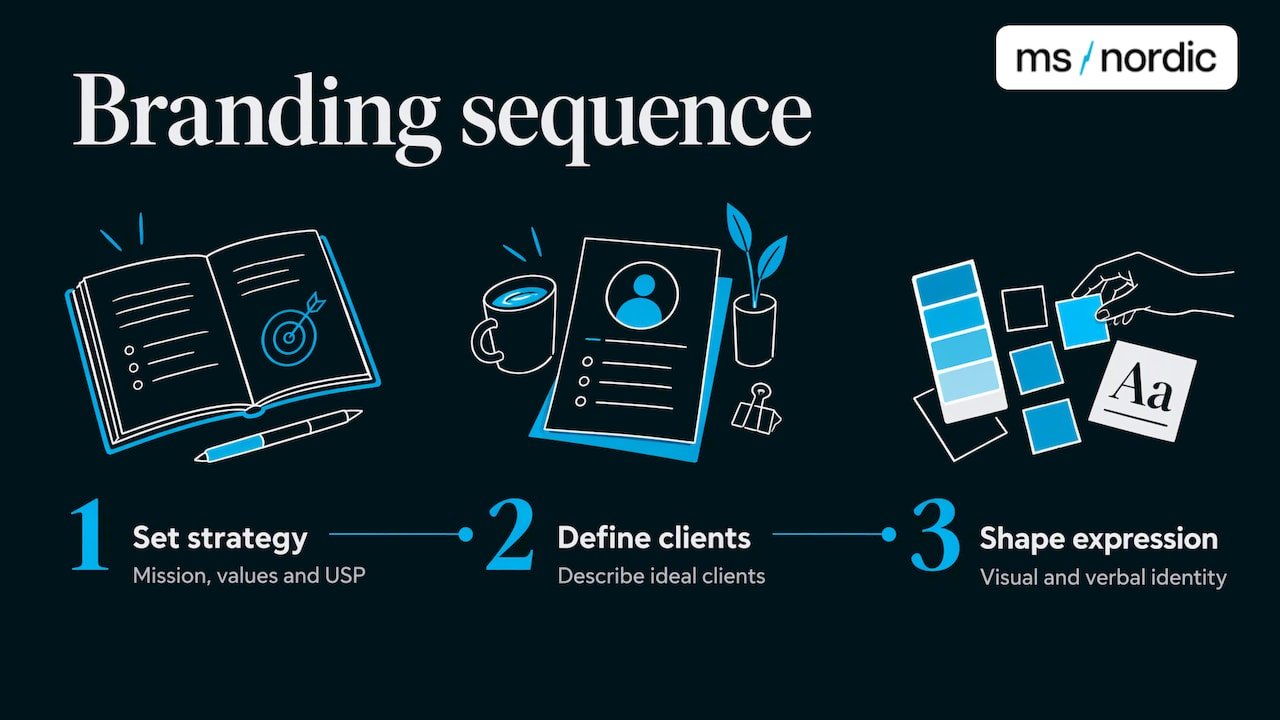
The most common mistake is to brief a logo first. The sequence that holds up is the one the American Bar Association’s September to October 2025 article recommends: define your mission, values and unique selling proposition (USP, the reason a client should choose you), then describe your ideal clients before you develop the visual or verbal expression.
Define who you serve
Describe the ideal client in three parts: who they are, what legal issues and goals they have, and where and how they look for legal help. A founder of a Danish software company registering a Spanish subsidiary looks for help differently from a family facing a probate dispute. They use different search terms, trust different referrers and expect different communication.
Write the positioning in one sentence
A usable positioning statement names the client, the problem and the difference. For example: “We advise Nordic scale-ups on employment and corporate matters when they open a Spanish entity.” If a partner cannot say it in one breath, the brand will drift. Inbound Legal’s 2026 marketing guide frames it usefully: brand is who you are, the USP is why a client should choose you, and messages are how you communicate that value.
Describe how you deliver
The ABA also defines a firm’s image through whom it serves, what it offers and how it delivers, including communications, billing, availability and response times. This is the part most design agencies skip, and it is where a brand becomes believable. If your promise is “clear, fast, jargon-free”, then your engagement letters, invoices and out-of-office replies need to be clear, fast and jargon-free too. For firms with high enquiry volumes, intake automation for personal injury firms is one example of how response times can be handled at scale.
The elements of a law firm identity
Once the strategy is fixed, the identity has a clear job. These are the components, in the order we would build them.
| Element | What it must do | Where it goes wrong |
|---|---|---|
| Name | Be easy to say, spell and search, in every market you serve | Surnames that are hard to pronounce abroad, or a meaning that changes in another language |
| Logo | Work at small sizes and across applications while expressing your values | Over-detailed marks that fail in an email signature or on a favicon |
| Colour and typography | Signal the right level of formality and stay legible on screen and in print | Defaults copied from competitors, so the firm looks like everyone else |
| Tone of voice | Sound like a person a client would want to call | Latin phrases and long sentences used as a signal of authority |
| Website | Explain who you help, show proof and make contact easy | A brochure with no clear next step |
| Client experience | Deliver the promise in communications, billing and response times | A polished brand with a slow intake process |
Clio recommends that a logo work across websites, email signatures, business cards, social media and other applications. We have written separately about why the logo is a small detail in a bigger picture: a mark matters, but only as part of a system of rules for colour, type, layout and language.
Keep the brand consistent across every touchpoint
Consistency is the cheapest way to look established. The ABA recommends keeping the same colours, logo, layout and tone across websites, social media and intake communications. Clio extends the list to advertisements, signage, business cards, email signatures, client intake and directory listings.
A practical audit takes an afternoon. Lay side by side your homepage, email signature, engagement letter, invoice, LinkedIn page and the first reply a new enquirer receives. If they look and sound like they came from different firms, you have found your first brief. Fixing this normally means a short brand guideline, covering logo use, colours, fonts, tone and example wording, plus templates for the documents your team writes every day. Our Brand and Identity service covers this kind of identity system, from strategy through to the guidelines your team applies.
Measuring whether the brand works
Branding is easy to treat as a one-off cost with no measurement. Law360 proposes a four-part brand audit covering recognition, reputation, relationships and revenue. Recognition is measured through awareness, reputation through sentiment, relationships through feedback from clients and referrers, and revenue through pricing and the business you win or lose. It also recommends compiling selected measures into a favourability barometer and reviewing it at least annually.
For a smaller firm, a workable version is to ask ten recent clients and five referrers how they would describe you in one sentence, then compare their words with your positioning statement. Repeat each year. The gap between what you intend and what people say is the work still to be done.
Branding a law firm for a new market
This is where law firm branding differs most from branding a consumer product. A firm expanding abroad is selling trust to people who have no history with it, in a language and legal culture that may differ from its own.
Adapt, do not just translate
A direct translation of a website keeps the words and loses the meaning. Tone, formality, the order in which proof is presented and even the colour associations can differ by country. We explain the difference in our guide to transcreation versus translation and set out the wider process in how to adapt your brand for a new market. For firms looking at Spain, our note on Spanish market localisation covers what to settle before launch.
Decide what stays fixed
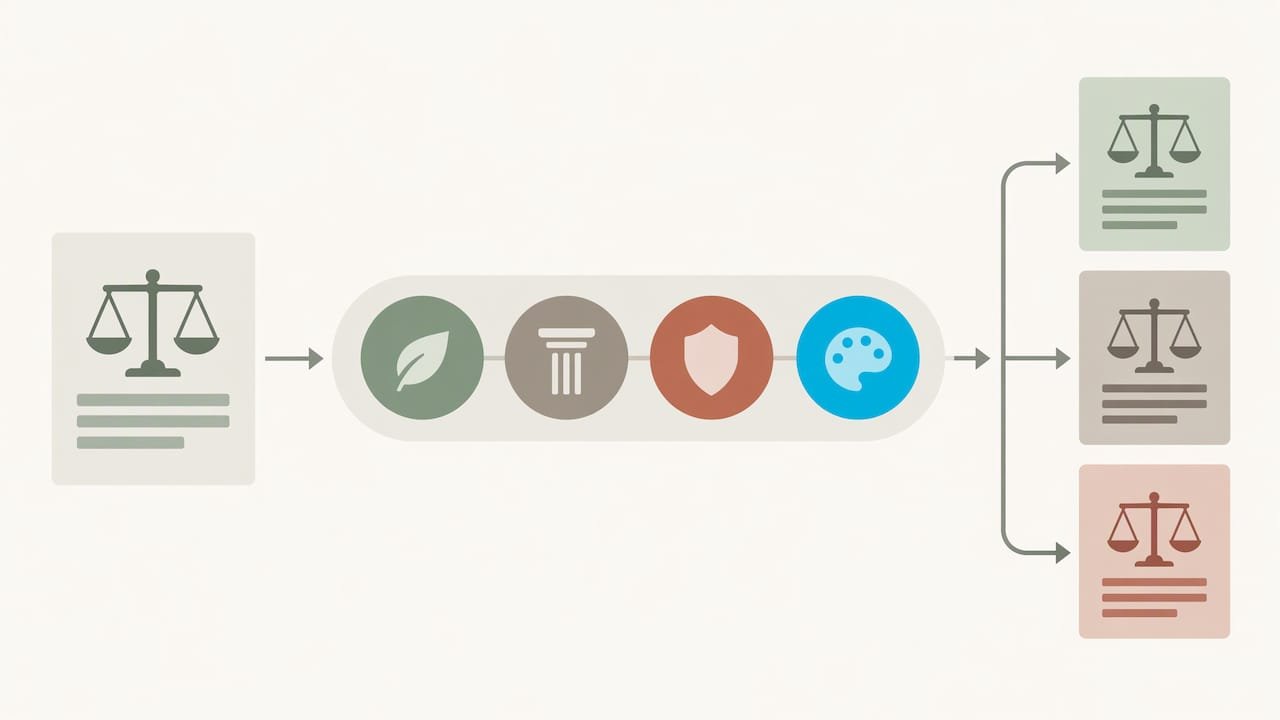
Set three layers before you start:
- Core, never changes: firm name, logo, values, quality standards.
- Flexible, adapts by market: tone, formality, headline messages, case examples, imagery.
- Local, built for the market: language, regulatory statements, client references, directory listings, contact routes.
For a Danish firm advising on Spanish matters, that could mean keeping the Copenhagen identity intact while the Spanish site speaks in a register that local clients expect and shows local proof points, such as Spanish-sector experience and named local contacts.
Check the advertising rules where you practise
Legal advertising is regulated, and the rules differ by jurisdiction. Some examples show the pattern. Arizona’s Rule 42 amendments require communications about lawyer services to include the name and contact details of a responsible lawyer or firm, allow advertising through written, recorded or electronic communications and public media subject to the ethics rules, and restrict giving value for recommendations apart from specified exceptions. Malaysian publicity rules reported as effective from 1 January 2026 widen what printed and electronic publicity is allowed while prohibiting misleading, false or unverifiable material and claims likely to create unjust expectations.
The practical lesson is the same everywhere: creative concepts, testimonials, fee claims and calls to action should be reviewed against the rules of the jurisdiction where the material will appear, before publication. In England and Wales that means your regulator’s rules for solicitors. In Spain and Denmark it means the rules of the relevant bar. Ask your compliance lead or regulator, and brief your designer with the answer. Taglines such as “the best” or “guaranteed results” are the first to cause trouble.
What this looks like in practice
Law is one of the sectors where we have delivered branding work. We completed a brand update, website design and visual identity system for Zafo Law, and you can see more of our identity work in our Branding and Strategy archive.
A step-by-step plan for your firm
- Audit. Collect your current materials and ask clients and referrers how they describe you.
- Strategy. Fix your audience, positioning, values and USP in writing.
- Name check. Confirm that the name works in each market, in speech and in search.
- Identity. Design the logo, colours, type and tone of voice as one system.
- Website and templates. Build the site and the everyday documents on that system.
- Compliance review. Check claims, testimonials and regulatory statements for each jurisdiction.
- Launch and align. Brief the whole firm, so that service delivery matches the promise.
- Review annually. Re-run the brand audit and adjust.
Our perspective
A new logo is a common starting point for a rebrand. What a firm needs first is a decision: who is this firm for, and what will it be known for? Once that is clear, the design work is faster and the result lasts longer.
Our work sits between strategy, creative and cultural fluency. For a firm crossing a border, that matters because the brand has to be recognisably the same firm and yet sound natural to a new audience. We work from Barcelona and Copenhagen, with partner agencies where a project needs them, and we focus on measurable outcomes.
Building bridges is what branding does for a firm in a new country. The identity is the first handshake, and the way you work is the second.
Jacob Munch
Work with MS Nordic
If your firm is entering a new market, rebranding or launching, we can help with the identity, the website and the localisation that connects them. Our services include Brand and Identity, digital presence and campaigns, and market entry support for Spain, the UK and the Nordics. See the full range on our services page and start a conversation.
FAQ
What is law firm branding?
It is the combination of your name, positioning, visual identity, tone of voice and client experience that shapes how clients and referrers see your firm. Branding covers more than a logo. It includes how you answer the phone, write emails and send invoices.
How is law firm brand identity different from reputation?
Brand identity is what you design and control: the name, logo, colours, words and website. Reputation is what clients say about you after using your services. A good identity sets the expectation, and good service delivery turns it into reputation.
Do lawyers need a different approach to branding than other businesses?
Yes, in two ways. Trust is the main thing a client buys, so credibility, clarity and responsiveness matter more than novelty. Advertising and publicity rules also limit what you can claim, so every message should be checked against the rules of your regulator.
What should a firm expanding abroad change about its brand?
Keep the core identity, name and values. Adapt the tone, the headline messages, the proof points and the language for each market, and include the regulatory statements the local rules require.
Sources
- Law Firm Branding Guide for Solo and Small Firms, Clio
- Why A Robust Brand Is Increasingly Important For Law Firms, Law360
- Branding: The Foundation of Practice Management, American Bar Association
- Effective Law Firm Branding: Tips for Solo and Small Firms, American Bar Association
- From Perception to Trust: How to Build a Strong Law Firm Brand, Bar and Bench
- Law Firm Marketing Strategy, Inbound Legal
- Order Amending Rule 42, Arizona Rules of the Supreme Court
- New Publicity Rules For Lawyers And Law Firms At Malaysian Bar