Local influencer marketing means partnering with creators who have earned the trust of people in one city, region or community, then letting them introduce your brand in their own voice. It works best when you need credibility fast in a place where nobody knows you yet. This guide shows you how to find the right creators, check that their audience is real and local, brief them properly and stay on the right side of UK advertising rules.
TL;DR
- A local influencer is based in the area you want to reach and creates content about that place, so their recommendation carries community credibility a national campaign cannot borrow.
- Find creators through location filters, geotags, local hashtags and event coverage, then verify where their audience actually lives. A creator’s address proves very little.
- Judge audience fit, engagement quality and tone before follower count. A smaller, relevant audience often beats a large, generic one.
- In the UK, paid or incentivised posts must be obviously labelled as ads, and the CMA can now fine brands directly for hidden advertising.
- Entering a new country? Local creators work best as one part of a localised brand, not as a patch for a brand that has not yet adapted.
Table of Contents
- What local influencer marketing is, and why it works
- When local creators are the right move
- How to find local influencers
- How to assess a creator before you approach them
- Approaching creators and writing the brief
- UK rules: disclosure and hidden advertising
- Measuring results
- Taking local influencer marketing into a new country
- Perspective: creators amplify a brand, they do not replace one
- How we can help
- A simple 30-day starter plan
- FAQ
- Sources
What local influencer marketing is, and why it works
A local influencer is based in the area a brand wants to target and creates content related to that town, city or region. The audience is geographically concentrated, often niche, and used to hearing recommendations about places, shops and services they can actually visit.
That has three practical effects.
- Trust travels with the creator. Their content and followers are tied to the community, so a recommendation reads as a neighbour’s tip rather than an advert.
- Cultural nuance comes built in. Local creators understand regional interests and community values and can convey your message without the awkwardness of a translated global campaign.
- Budgets stretch further. Smaller audiences can make partnerships more budget friendly, with less competition for attention.
If you want the wider picture of how creators fit into brand growth, this overview of influencer marketing strategies is a useful companion.
Local, micro and national: how they differ
| Local influencer | Micro-influencer | National influencer | |
|---|---|---|---|
| Audience | Concentrated in one city or region | Niche, may be spread across countries | Broad, mixed geography |
| Best for | Openings, launches, events, regional trust | Category credibility | Mass awareness |
| Main risk | Small reach per creator | Audience may not be near you | Generic, costly, less trusted |
| Measurement | Codes, store visits, local bookings | Clicks, codes | Reach, brand lift |
The categories overlap. One creator with 15,000 followers in Manchester is both local and micro. What matters is whether the people watching can act on what they see.
When local creators are the right move
Local influencer marketing suits businesses with a place-based goal:
- opening a shop, showroom or pop-up;
- launching a product in a new country or city;
- promoting a service that depends on location, such as hospitality, clinics, fitness or events;
- giving a foreign brand a human face in a market where it has no reputation.
It suits you less when your product ships anywhere and your difference is purely functional. In that case, the creator’s niche matters more than their postcode.
One caution: creators amplify what you already are. If your name, tone or visuals do not make sense to the local audience, a creator will not fix that. Settle your identity first. Our guide to brand localisation explains how to adapt a brand before you put it in front of a new audience.
How to find local influencers
Start wide, then narrow. A workable process looks like this.
1. Search the platforms by place
Search geotags and location pages on Instagram and TikTok, then check recent posts rather than only top posts. Look at location-specific hashtags and recent content, and review creators across Instagram, TikTok and YouTube instead of relying on one platform. Discovery tools let you search creators by topic, hashtag, location, name or handle using public profile information.
2. Use search engines and the real world
Combine your category with the city in Google (“vegan café Leeds blogger” works better than a generic term). Then go offline in spirit: who covers local events, openings and markets? Who do your existing customers tag? Customer mentions are often your best shortlist.
3. Verify the audience location
This is where most campaigns go wrong. Guidance on building a shortlist recommends narrowing by creator location, audience location, niche, platform, recent activity and audience quality, and opening recent content because a creator’s address does not prove the audience is local. Ask every creator for their platform analytics showing follower location by city. A reputable creator will share it.
4. Build a shortlist of five to ten
Keep a simple sheet: handle, platform, city, follower count, audience location, engagement notes, content style, past brand work. You will drop half after the next step.
How to assess a creator before you approach them
Follower count is the least useful number on the profile. A better checklist:
- Audience: demographics, location and interests match your customer.
- Engagement quality: read the comments. Real conversations, shares and click-throughs say more than likes; a professional guide on mapping local creators puts audience alignment and engagement quality ahead of follower count.
- Credibility: do they know the subject, and do local people treat them as a reliable voice?
- Tone and values: would you be comfortable seeing your brand beside their other content?
- Disclosure habits: do they already label paid work clearly?
- Signs of fake activity: sudden follower spikes, generic comments, engagement out of proportion to audience size.
One framework makes the point that a smaller audience with genuine buying relevance can be worth more than a large, generic one. Some practitioners suggest local micro-influencers of roughly 1,000 to 50,000 followers as a responsive segment, which is a sensible place to start looking, not a rule.
A note on shortcuts: never buy followers or engagement to make a campaign look healthier. It corrupts the very signals you are using to judge a creator, and it wastes budget on people who will never visit your shop.
Approaching creators and writing the brief
Creators receive generic pitches daily. To stand out:
- Engage with their content genuinely before you write.
- Personalise the message and say why they fit this market.
- Offer a clear value exchange, whether fee, product or both.
- Consider starting with a small initial project before committing to a long programme.
- Protect their relationship with their audience. Overly promotional scripts damage the trust you are paying for.
What the brief and contract should cover
Industry best-practice papers agree on the essentials. A professional white paper on influencer marketing lists objectives, target audience, brand positioning, budget and remuneration, scope, do’s and don’ts, content references, mandatory hashtags and mentions, deliverables, timeline and paid-media requirements. Another industry guide adds exclusivity, review and approval rights, posting destinations, usage rights and the production schedule.
Turn that into a one-page checklist:
- Objective and one primary metric.
- Audience and location.
- Deliverables, formats and posting dates.
- Fee, payment terms and any gifted product.
- Disclosure wording and who checks it.
- Approval steps and turnaround times.
- Usage rights: can you reuse the content, where and for how long?
- Exclusivity: are competitors off limits, and for how long?
- Paid-media permission, if you want to boost their posts.
Leave creative room. Give them your message and your limits, not a script. Their audience follows them for their voice.
UK rules: disclosure and hidden advertising
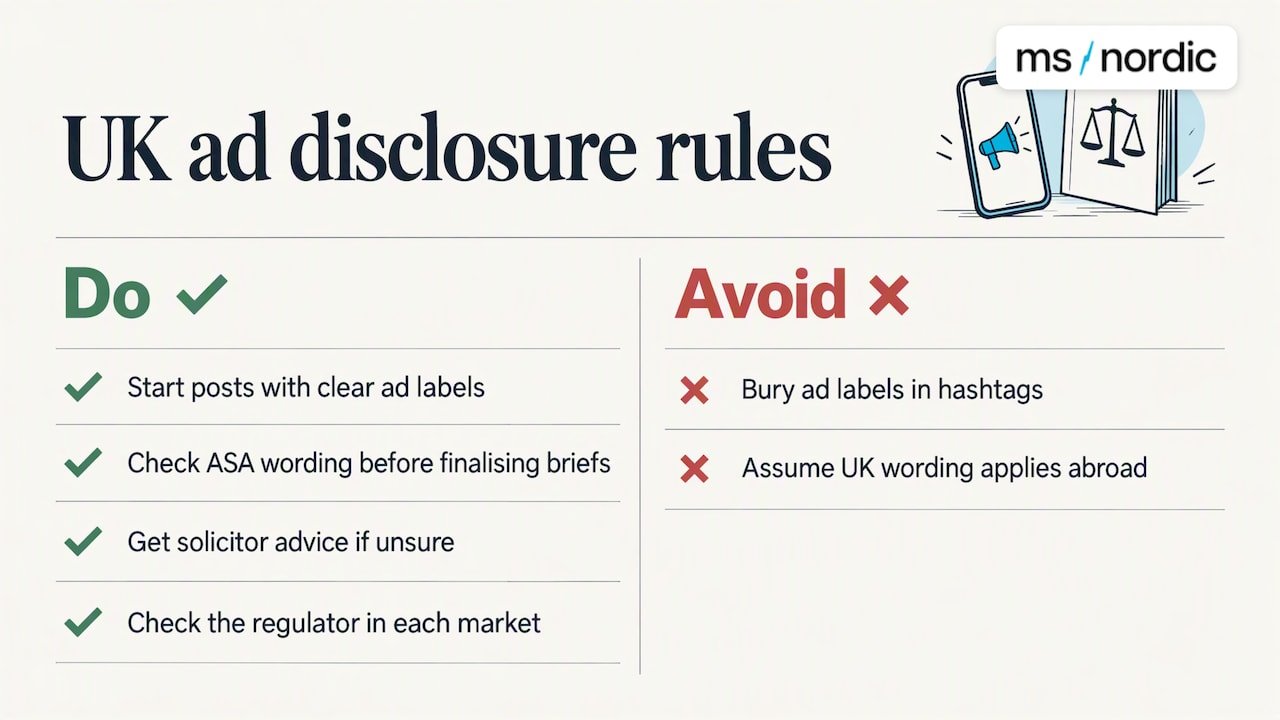
If you run a campaign in Britain, this is not optional reading. Section 2 of the CAP Code requires that marketing communications are obviously identifiable as such, and influencer posts are a category where that line can blur. The ASA can act where a brand has editorial control over content, and both the brand and the creator can be held responsible.
In practice, ask creators to label paid, incentivised or brand-controlled posts clearly at the start of the post, with a plain term such as “Ad”, rather than burying it in hashtags. Check the ASA’s current wording guidance before you finalise your brief.
The stakes have also risen. The CMA states that hidden advertising is harmful and illegal, and that under the Digital Markets, Competition and Consumers Act 2024 it can issue fines and directions directly to those who break consumer protection law. If you are unsure whether a particular arrangement counts as an ad, take advice from a solicitor who handles advertising law, and write the answer into the contract.
Running campaigns in other countries? Rules differ by market, so check the national advertising regulator before you brief creators there. Do not assume UK wording carries over.
Measuring results
Decide how you will measure before the first post goes live.
- Unique promo codes per creator show which partnerships drive sales. Local campaigns can also use in-store events to drive sales and foot traffic.
- Trackable links with UTM parameters show visits and conversions online.
- Booking or enquiry questions (“How did you hear about us?”) catch what links miss.
- Saves, shares and comments show whether the content landed, which matters more than raw views.
- Local search and map activity often rise after a campaign: watch branded searches and direction requests.
Compare cost per result across creators after the first round. Keep the two or three that perform, and drop the rest. A small paid test gives you this data before you commit a larger budget.
Taking local influencer marketing into a new country
This is where our work sits. When a company enters a foreign market, local creators solve a real problem: you have no reputation, and your audience has no reason to take your word for anything. A trusted local voice borrows credibility for you, provided the brand underneath is ready.
The pattern we see in market entry:
- Define the brand locally. Name, tone, visuals and claims need to make sense to people who do not share your home market’s references.
- Choose creators who fit the culture, not just the category. A Danish brand entering Spain, or a Spanish brand entering the UK, needs creators who understand how local people talk about the product.
- Plan the campaign as part of a wider launch. Creator content should point to a landing page, shop or booking path that is also localised.
- Test small, then scale. One city, a handful of creators, clear metrics.
Our articles on Spanish market localisation and what Spanish market entry means for foreign brands go deeper on that groundwork. For the campaign mechanics, see our step-by-step digital campaign planning framework, and for how this differs from marketing as a whole, go-to-market versus marketing.
Perspective: creators amplify a brand, they do not replace one
We work between Barcelona and Copenhagen, so we see the same mistake from both directions. A company decides it needs influencers in a new market, hires a few creators, and wonders why the results are thin. The creators were fine. The brand was not yet ready to be seen locally.
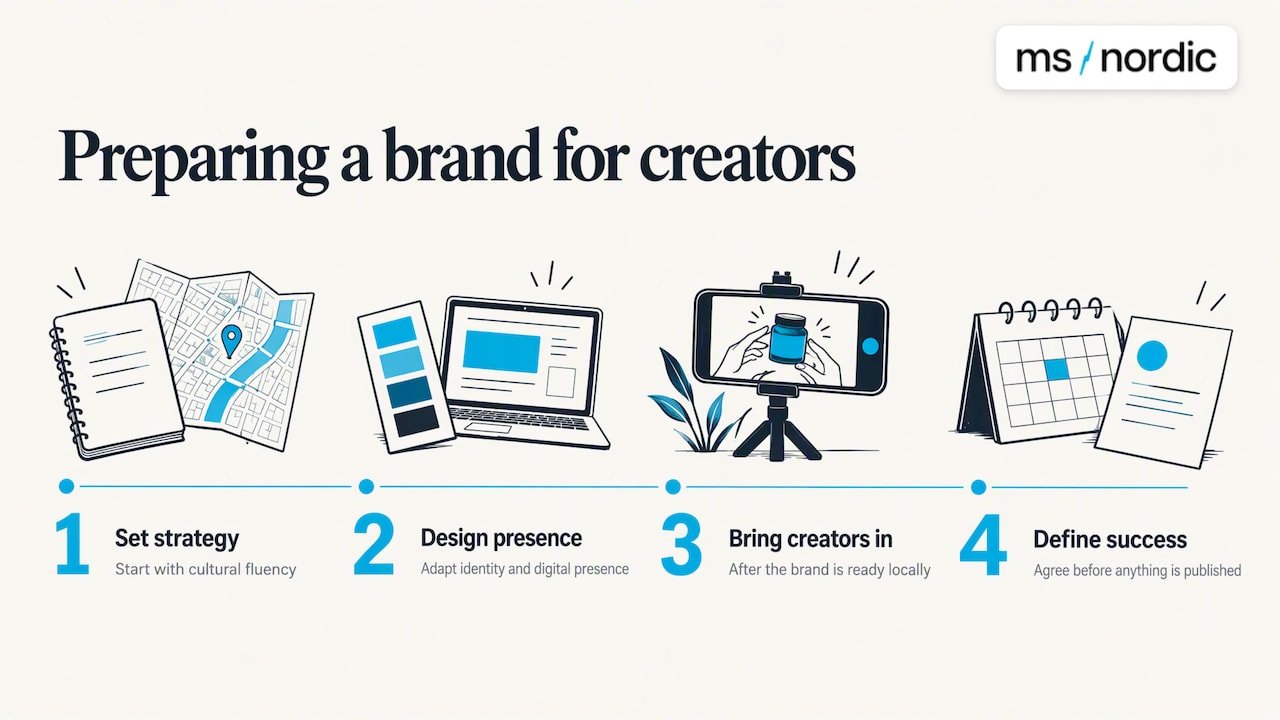
Our view is simple. Branding comes before marketing. If the identity, language and offer have not been adapted to the people you want to reach, a local voice can only draw more attention to the gap. If they have, a local creator becomes one of the fastest ways we know to build bridges between a brand and a community that has no reason yet to trust it.
So we start with cultural fluency and strategy, then design the identity and digital presence, and only then bring creators in. We usually work alongside partner agencies and on-the-ground talent, and we agree on what success looks like before anything is published.
— Jacob Munch
How we can help
If you are preparing to enter Spain, the UK or the Nordics, we can take you from market entry strategy and brand localisation to the campaign that introduces you to local audiences. See our Digital Presence & Campaigns service or the full list of services. Ready to talk it through? Start a conversation.
A simple 30-day starter plan
- Week 1: define one city, one goal and one metric. Confirm your brand and landing page work for local visitors.
- Week 2: search by location, build a shortlist of ten, verify audience location and engagement.
- Week 3: send personalised outreach to five, agree briefs, disclosure wording and codes.
- Week 4: publish, monitor comments, answer questions quickly and collect data.
Then review. Which creators drove action, which content got saved or shared, and what would you change in round two?
FAQ
How do I find influencers near me?
Search geotags, location pages and local hashtags on the platforms your customers use, then add Google searches combining your category and city. Check who covers local events and who your customers already tag. Always confirm through analytics that the audience, not just the creator, is based locally.
How many followers does a local influencer need?
There is no fixed number. Many brands start with local micro-influencers in the low thousands to tens of thousands because their audiences can be more engaged and affordable. A creator with 5,000 genuinely local followers can be worth more to a neighbourhood business than one with 500,000 spread across the world.
Do UK influencers have to say when a post is an ad?
Yes. Under the CAP Code, ads must be obviously identifiable as ads, and the ASA can act against both brands and creators. The CMA can also fine businesses directly for hidden advertising. Agree clear labelling in the contract and check current ASA guidance before posting.
Is local influencer marketing worth it for a company entering a new country?
Often, yes, because it gives an unknown brand local credibility quickly. It works best when your brand, website and offer have already been adapted to the market. Start with a small test in one city and measure with codes and trackable links before scaling.
Sources
- How to find local influencers to promote your brand
- Think Global, Act Local: How Influencers Drive Regional Success
- 3 Tips for Launching a Product with a Local Influencer
- Influencer Marketing Strategies That Drive Real Brand Growth
- How to Find Local Influencers For Your Brand
- Creator Discovery, Later Influence Help Center
- How to find local influencers: 7 practical ways
- Mapping your local influencer landscape
- Creator-Led Marketing Toolkit
- How to find influencers by location
- Utilizing Local Influencers For Digital Marketing Success
- Digital Influencer Marketing Best Practices White Paper
- Influencer Marketing for Publishers
- Recognising ads: Social media and influencer marketing, ASA
- Hidden ads principles for social media platforms, GOV.UK