How people search, compare and decide is changing faster than at any time since Google became a verb. For businesses, that means rethinking what it actually takes to be found online.
For years, online visibility was more or less a synonym for ranking well on Google. SEO still matters, and it is not going anywhere, but it has entered a new phase. Artificial intelligence, AI-generated answers, constant changes to Google Search, social media, video and local search are reshaping how customers discover businesses and how they make up their minds. We follow these changes closely and adapt how we build and manage our clients’ digital presence along the way. Our aim is simple: to help clients prepare, rather than react.
The customer journey has changed
The classic model was straightforward. Someone typed a search, Google showed a list of websites, the user clicked, and the website got a visit. That journey still exists, but it is no longer the whole story. Google now answers many questions directly in the results, and AI summaries combine information from several sources before anyone visits a website at all.
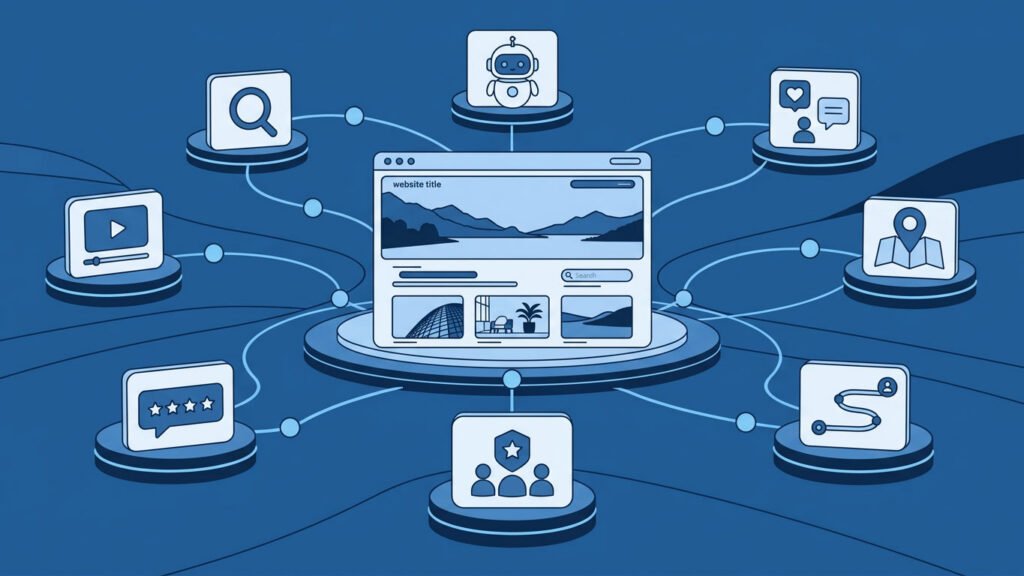
A typical journey today might start with a post on Instagram, continue with a quick Google search, an AI answer, a YouTube video and a look at the reviews, and only then end on your website. Sometimes it ends with a competitor instead. Visibility is no longer about one search engine and one visit. It is about being present, and convincing, across the whole journey.
Why organic traffic is shifting
Many businesses are seeing changes in their organic traffic, and the natural reaction is to look for something broken. Sometimes there is a technical issue or a content problem. Often, though, the search landscape itself has changed. A website can hold a strong position and still receive fewer clicks, simply because more of the answer is shown directly in the results.
That is why rankings and traffic on their own no longer tell the full story. To understand what is really happening, you need to look at visibility, impressions, click-through rates, search intent, conversions and brand presence together, and above all at the business results they lead to.
A busy year for Google
2026 has been an eventful year in search. Google’s Search Status Dashboard lists a March spam update, a March core update, a May core update and spam updates in June, August and September, the last of which finished rolling out on 7 October. Each of them can change how websites are evaluated and where they appear.
It is worth remembering that a core update does not mean a website has done something wrong. Core updates are broad changes designed to improve the overall quality of results, not penalties aimed at specific sites. Google may simply reassess which page answers a question best, how authority and relevance should be weighed, or whether newer content deserves to rank higher. Think of a list of the best restaurants in town, written a few years ago. When it is updated, some places move down without having become any worse. Others have simply opened, improved or become more relevant. Positions in search are never owned. They are earned again and again.
Spam updates work differently. They target manipulation, and Google uses automated systems, including its AI-based SpamBrain, to detect it. When these systems improve, certain links can lose their value, some SEO techniques stop working, and competitors may move up or down. Even legitimate businesses can feel the effect without having done anything intentionally wrong. So when traffic changes suddenly, it pays to investigate carefully before drawing conclusions.
Search is being rebuilt around AI
Ranking updates are only part of the picture. Google is integrating generative AI ever more deeply into search through features such as AI Overviews and AI Mode. Behind the scenes, Google can run several searches at once, combine sources and present a fuller answer directly in the results.
This changes the relationship between visibility and traffic. Your business can appear in an answer, and even influence a decision, without anyone clicking through to your website. Visibility and traffic should therefore be measured as two separate things.
Google is adjusting its own tools to match. In June 2026 it introduced performance reports in Search Console that show impressions from AI Overviews and AI Mode separately, and by the end of August they had been rolled out to websites worldwide. In July, Google went a step further with Search Console properties for Instagram, TikTok, X and YouTube, showing how content from those platforms is discovered through Search and Discover. The message is clear: the boundaries between websites, search, social media and video are fading, and a strong digital presence needs to connect them.
Why Google is making these changes
There is more content online than ever, and AI makes it faster and cheaper to produce. At the same time, people expect more from search. They want help understanding a topic, comparing options, finding a local business or making a difficult decision. Google keeps adjusting its systems to judge what is genuinely useful, reliable and relevant, and generative AI allows it to break complex questions into several searches and bring the answers together. The result is a search experience that is fundamentally different from the one most businesses optimised for just a few years ago.
SEO is not disappearing, it is growing up
If anything, SEO matters more than before. The foundations remain the same: technical health, speed, indexing, clear page structure, internal linking, quality content, structured data, mobile usability, local SEO and accurate business information.
What is changing is the purpose. SEO is moving away from building pages around individual keywords and towards a website that works as a trusted resource. A site that makes it clear who you are, what you offer, which problems you solve, who you are for and why people should trust you, in a way that people, search engines and AI systems can all understand.
The website remains the centre of it all. It is where you control your own story, show your expertise, present your offer and turn visitors into customers. But it now needs to support a wider presence across search, AI, social media, video, local listings and your brand as a whole.
Content needs more substance
Generic content has lost much of its value. When the same information is available everywhere, and AI can summarise it in seconds, there is little reason to visit a page that simply repeats it. The content that stands out is rooted in real experience: your expertise, your products and services, your projects, your customers and your local knowledge. Case studies, practical guides, honest comparisons, answers to the questions customers actually ask, and original images and video all help make your business a recognisable and useful source in its field.
One journey, many platforms
Picture a customer who discovers your brand on social media, watches a video, searches for your name on Google, reads an AI Overview, checks your reviews, compares you with a competitor and finally visits your website to get in touch. Each of those moments shapes the decision. That is why your website, social media, video, Google presence and brand should not be managed as separate channels. They work best as one connected strategy, where each part supports the others.
Traffic alone is no longer the goal
Traffic still matters, but it does not define success. A business can lose informational visitors while sales stay stable, and a website can attract plenty of visitors who never become customers. What really counts are qualified visitors, enquiries, leads, sales and conversion rates, supported by visibility in commercial searches, brand searches, local results and AI-driven search. The objective is not more traffic. It is better visibility that contributes to the business.
Why now is the time to act
None of this means abandoning SEO. It means letting it evolve. Google’s own guidance still emphasises useful, people-first content, technical accessibility and clear structure, and it advises site owners to look carefully at traffic changes rather than make drastic changes after every update. Our approach follows the same logic. Rather than chasing each update, we build stronger foundations, and when something changes, we first make sure we understand what changed and why.
How we can help
A digital presence cannot be optimised once and left alone. We keep a close eye on Google Search, AI-driven search, social and video platforms, website technology and user behaviour, and we keep evolving our methods with the market.
For our clients, this often starts with a new kind of digital review. Instead of only asking where you rank on Google, we ask questions such as:
- Are we attracting the right visitors?
- Are rankings stable while clicks are falling, and if so, why?
- Which pages generate enquiries or sales, and which are losing traffic?
- Is our content clear and well structured for both search engines and AI?
- Do we demonstrate real expertise, and is our offer easy to understand?
- How visible are we beyond Google?
The answers help separate genuine SEO problems from changes in how search traffic is distributed. From there, we can analyse your Search Console data, review your visibility in AI search, improve technical SEO and structured data, restructure content and service pages, strengthen local visibility, connect your channels and set up tracking that measures what really matters. Every business is different, so the solution always starts with understanding where you are today.
A new question to ask
SEO, Google and websites are not disappearing, but the relationship between them is changing. Search is becoming more intelligent, AI is now part of how people discover businesses, and social media and video are connected to search in ways they were not before. Businesses need a broader definition of visibility, and a presence that can adapt as Google, AI and customer behaviour continue to evolve.
For years, the key question was simple: where do we rank on Google? Today, a better question is this: can our customers find, understand and trust our business wherever they choose to search?
That is the new challenge, and it is exactly what we help our clients prepare for. If you would like to know how your business is positioned, get in touch for a conversation about your online visibility.