
Brand localization is the work of adapting your brand’s messaging, visuals, product presentation and customer experience to a specific market, while keeping the core identity that makes you recognizable. It goes far beyond translation. Done well, a local customer sees a brand that understands them. Done badly, they see a foreign company that pasted its home-market assets onto a new language.
This guide is for founders and marketing leaders preparing to enter a new country. It covers what to adapt, in what order, how to build a localization strategy, and where companies lose money.
TL;DR
- Brand localization adapts messaging, visual identity, imagery, channels and experience to a local market. Translation is only one small part.
- Work in layers. Get the technical basics right first (currency, dates, addresses), then adapt tone, imagery and narrative.
- Global brands tend to be seen as competent but cold. Your job in a new market is to add local warmth and authenticity.
- Decide what stays fixed (positioning, values, logo system) and what flexes (language, examples, channels, offers) before any design starts.
- Test with local people before launch, then keep showing up. One campaign will not build trust.
Table of Contents
- What brand localization actually covers
- Why a global brand needs local warmth
- The localization pyramid: what to adapt first
- How to build a brand localization strategy
- Frequency matters: the 3-7-27 rule in a new market
- Common mistakes in brand localization
- Our perspective
- Where to start if you are entering Spain, the UK or the Nordics
- How MS Nordic can help
- FAQ
- Sources
What brand localization actually covers
Think of your brand as three things: what you say, how you look and how it feels to buy from you. Localization touches all three.
- What you say: headlines, tone of voice, humor, formality, claims, taglines, product names.
- How you look: color associations, imagery, people shown, layout density, packaging, logo variants.
- How it feels to buy: currency, payment methods, delivery expectations, address formats, support hours, local proof such as reviews and partners.
The usual summary from major examples is simple: keep the brand’s core, change the surface. McDonald’s is the textbook case. It adapts its menu to local customs, with vegetarian options in India and kosher meals in Israel, yet stays unmistakably McDonald’s.
Localization, translation and globalization
Translation converts words. Localization converts meaning, context and experience. Globalization, in the branding sense, means one consistent brand everywhere. Most successful companies sit between the two. Researchers describe the old global-versus-local debate as increasingly obsolete: growth now depends on showing cultural respect, meaning the brand integrates local cultural capital into its identity.
Why a global brand needs local warmth
Research on brand perception gives a useful warning. Davvetas and Halkias found that global brands are often stereotyped as competent but lacking in warmth, while local brands are seen as warmer. If you arrive in a new market leaning only on “we are international and capable,” you reinforce the cold stereotype.
The fix is not to hide where you come from. It is to show up with local authenticity: local voices, local proof, local references, and a clear reason you care about this market.
A study of McDonald’s in Indonesia points the same way. It found that brand authenticity mediates between how global or local a brand seems and how people feel about it. Brands that paste global assets onto local platforms risk feeling inauthentic. Brands that blend the two feel honest and consistent. For a practical look at why this matters commercially, see this piece on how authenticity in branding builds trust.
There is also an out-group effect. When a brand fails to show cultural respect, consumers can classify it as an outsider, and exclusionary reactions can follow regardless of product quality.
The localization pyramid: what to adapt first
Localization is not an on/off switch. Website research describes a pyramid of cultural markers, moving from technical basics up to deeper cultural layers. Practitioners work from the bottom.
| Level | What it covers | Examples |
|---|---|---|
| 1. Technical baseline | Formats and standards users expect | Currency, date formats, address structure, units, payment methods, navigation conventions |
| 2. Language and tone | How you sound | Local vocabulary, formality, humor, claims you can and cannot make |
| 3. Visual and imagery | How you look | People shown, color meaning, layout density, photography style |
| 4. Values and narrative | Why you matter here | Local stories, partnerships, community role, product or service tweaks |
The common pitfall is jumping to level 4 before level 1 is solid. A beautiful local story loses power if the checkout asks for an address in the wrong format. The same research notes that even basic mistakes like zip-code-first address entry can push abandonment up in markets where that format is standard.
The same paper reports that studies of hundreds of global sites identify nearly 20 culturally sensitive design elements, including headline prominence and social network integration, that affect trust and conversion in specific regions.
Cultural dimensions as a design lens
Hofstede’s cultural dimensions, such as individualist versus collectivist, are a common way to reason about visual and message choices. Research on website redesign uses them to explain why user requirements differ between cultures. Treat them as a starting hypothesis, never a verdict. Local interviews beat any model.
Coca-Cola’s “Share a Coke” is a clear illustration of the idea. Per one roundup of localization examples, Australian bottles carried common first names, while in China the phrases leaned toward relationships such as “Classmate” or “Best Friend”, reflecting a stronger group orientation. Same idea, local expression.
How to build a brand localization strategy
A workable strategy is a sequence of decisions. Here is the order we recommend.
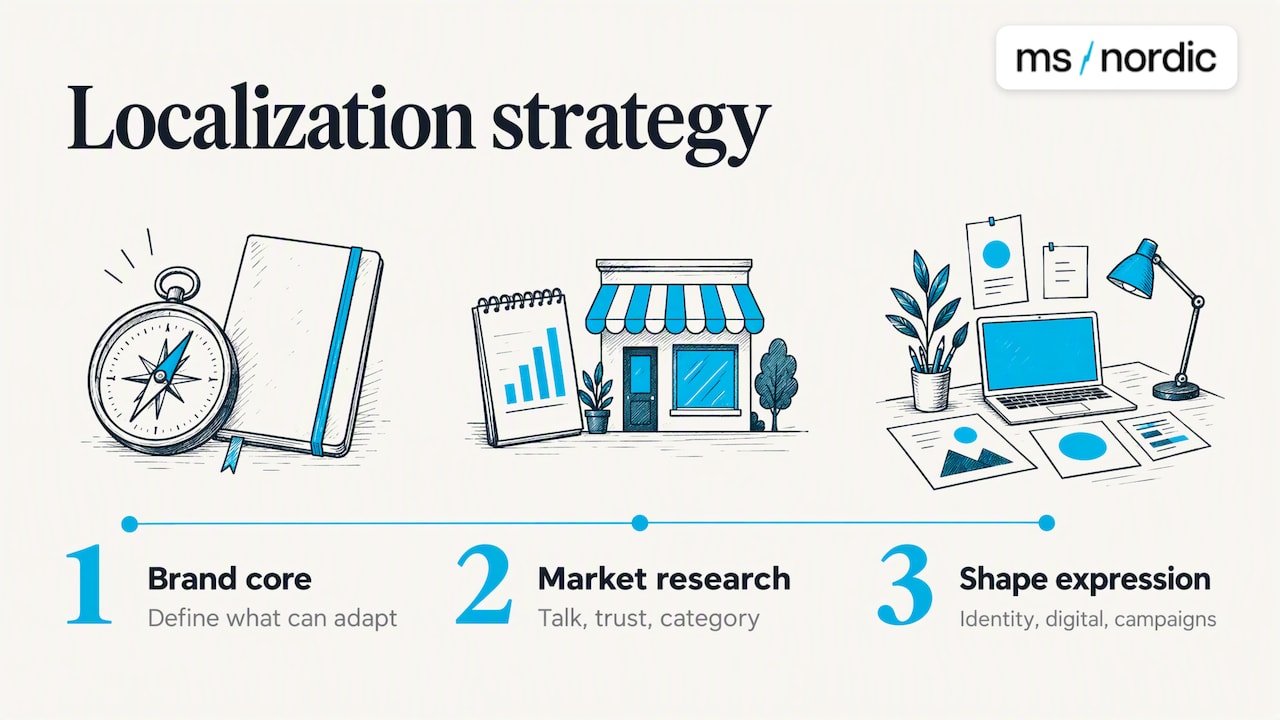
- Define the core. Write down what must never change: positioning, values, the logo system, quality standards. If you cannot state it in a page, it is not ready to travel.
- Research the market through local eyes. Interview local customers, study local competitors by type and category, and read how people actually talk about your category. Native speakers and local partners are worth more than desk research.
- Audit your brand with the 5 C’s. Check Clarity, Consistency, Credibility, Connection and Commitment. A pre-launch diagnostic using these five helps surface messaging dissonance before the market does. Ask: is our positioning obvious to a local reader? Do we have local proof? Is the team aligned?
- Map the pyramid. For each level, list what you will keep, adapt or create from scratch.
- Adapt identity and messaging. Build local variants: tone guidelines, headline territories, imagery rules, a flexible logo and color system. A flexible logo that works across color schemes makes it easier to respond to local preferences and accessibility needs without losing recognition.
- Localize the experience. Website, store, checkout, packaging, support, sales materials. Make sure the digital experience matches the brand promise.
- Test locally, launch, then iterate. Put drafts in front of local people who are not on your payroll. Fix what confuses them.
Decide what flexes and what stays
A simple table keeps teams honest.
| Keep fixed | Let flex |
|---|---|
| Positioning and core promise | Language, idiom, examples |
| Values and quality bar | Humor, formality, claims |
| Logo and core visual system | Imagery, color emphasis, layouts |
| Customer experience standards | Payment, delivery, support hours |
The research summary above is not a license to dilute. A localized brand should still be recognizable as one brand in every market.
Frequency matters: the 3-7-27 rule in a new market
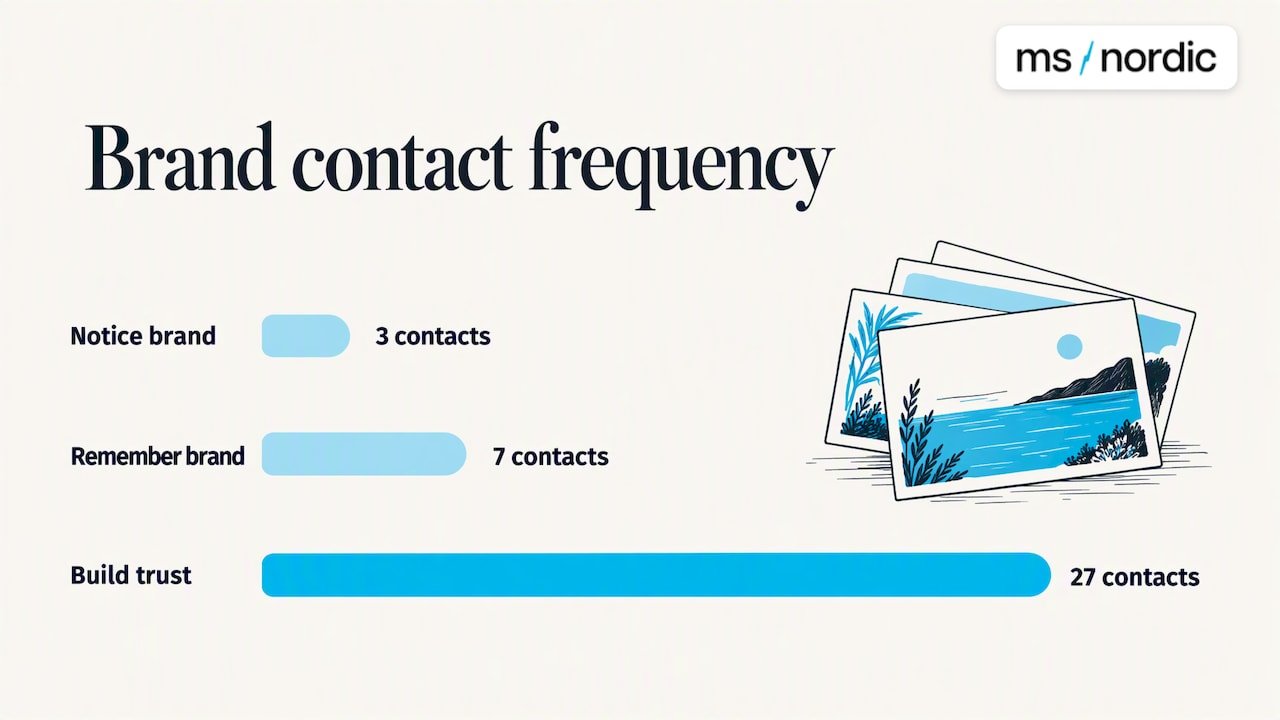
You will hear about the 3-7-27 rule: roughly 3 interactions to notice a brand, 7 to remember it and 27 to build trust. Treat it as a frequency baseline, not a guarantee.
In a new market, the lesson is to make each set of contacts do a different job rather than repeating one global message 27 times:
- Around 3 contacts: awareness. Be visible in the channels locals use.
- Around 7 contacts: local utility. Show something useful in the local context, such as local pricing, delivery or case examples.
- Around 27 contacts: trust and emotional resonance. Consistent, culturally fluent presence over time.
One-off launch campaigns are not enough. Plan a content and campaign rhythm for the first year.
Common mistakes in brand localization
- Translating and calling it done. Literal copy often reads as foreign even when grammatically perfect.
- Skipping the technical baseline. Wrong formats and missing local payment options undermine everything above them.
- Over-localizing. Changing so much that the brand loses its identity confuses existing customers and global teams.
- Leaning on global competence only. This feeds the cold-outsider stereotype.
- Treating local as one market. Regions, languages and generations inside a country differ. Spain, for example, has several languages and strong regional identities.
- No local voice. Without local partners, reviewers or team members, blind spots are almost guaranteed.
Our perspective
We work from Barcelona and Copenhagen, and most of our conversations start the same way: a good brand at home, unsure how it will land abroad. Our view is that localization is a strategy question before it is a design question.
First, we ask what the brand stands for and what it can adapt. Then we look at the market: how people talk, what they trust, what the category looks like. Only after that do we touch identity, digital presence and campaigns.
We also believe in building bridges rather than replacing one identity with another. Strategic insight, creative craft and cultural fluency have to work together. If you only have the craft, the work looks good and misses. If you only have the insight, it reads right but feels flat.
We often work alongside partner agencies and local specialists, because authenticity is easier when local people are in the room. And we try to tie the work to outcomes you can measure, such as launch results, visibility and conversion, rather than to taste alone.
Our advice for a first market entry: be precise about the core, humble about the local context, and consistent after launch.
— Jacob
Where to start if you are entering Spain, the UK or the Nordics
If your next market is Spain, our articles go deeper on localization strategy before you launch and on what a culturally specific brand language means for entry. If you are thinking about positioning before promotion, read why destinations must define themselves first. It applies equally to companies.
To see how localization work looks in practice, browse our branding and strategy projects.
How MS Nordic can help
We support businesses entering new markets with brand and identity work, digital presence and campaigns, e-commerce, prototyping and market entry strategy. Our focus areas include Spanish market entry, startup launches and export to the UK and the Nordics.
If you want a brand that feels local without losing what makes it yours, explore our Brand & Identity service, see the full list of services, or go straight to the MS Nordic homepage and start a conversation.
FAQ
What is an example of brand localization?
McDonald’s adjusting its menu to local customs is the best-known case, with vegetarian options in India and kosher meals in Israel. Coca-Cola’s “Share a Coke” is another: names in Australia, relationship phrases in China. In both, the core brand stayed intact while the expression changed.
What is the 3-7-27 rule in branding?
It is a rule of thumb that people need about 3 interactions to notice a brand, 7 to remember it and 27 to trust it enough to buy. It is a baseline, not a guarantee. In a new market, use each stage to deliver different, locally relevant value rather than repeating one message.
What are the 5 C’s of branding?
Clarity, Consistency, Credibility, Connection and Commitment. They work as a diagnostic: is your positioning clear, is your look and tone consistent across platforms, do you have proof, does the brand connect emotionally, and is the organization behind it. Running this check before launch helps catch problems early.
How is brand localization different from translation?
Translation changes the language of existing content. Localization also adapts tone, imagery, formats, channels and the buying experience so the brand feels native. Translation alone can come across as inauthentic and mark you as an outsider.
Sources
- Glocalization, EBSCO Research Starters
- Global and Local Brand Stereotypes: Formation, Content Transfer, and Impact
- The Dual Path to Brand Attitude: McDonald’s Indonesia and Brand Authenticity
- Rodrigues and Montanari, global versus local brands and cultural respect
- A Pyramid of Cultural Markers for Localized Website Design
- Cultural markers and website design study
- Culture and Website: User experience in website redesign
- Brand Your Business: Essential Strategies for Effective Branding
- A strategic guide to brand growth, Simon-Kucher
- Logo and Branding: How To Make Them Work Together, Shopify
- The best localization examples, Lokalise