
A rebrand costs anywhere from a few thousand pounds for a visual refresh to six figures for a full programme with strategy, identity, website and rollout. The price follows scope, not the word “rebrand”. If you are moving into a new market, the biggest lever is deciding early how much of the brand must change for the new audience, and how much can stay. That decision, made before design starts, is what keeps the budget under control.
We work with companies that are entering new markets, such as Danish businesses exporting to Spain, and startups that need a market-ready identity. This guide shows how rebrand budgets are built, where the money goes, and what gets missed.
TL;DR
- Published ranges are wide because “rebrand” covers everything from a logo refresh to a new name, strategy, website and launch.
- Agency-led rebrands for small and mid-sized firms commonly sit between about $15,000 and $75,000 in US sources. Swiss SME projects often run CHF 30,000 to CHF 150,000.
- Implementation (website, signage, legal, rollout) often adds 30% to 50% on top of the core design fee.
- A new market adds localisation: language, legal wording, local tone and channels.
- Fix the scope, the market and the rollout plan before you ask for quotes, so the quotes can be compared.
Table of Contents
- What a rebrand actually costs
- What you are paying for
- The factors that move the price most
- The costs most budgets miss
- When the rebrand is for a new market
- How to control the budget without weakening the result
- What good looks like in practice
- Our view on rebranding budgets
- Plan your rebrand with us
- FAQ
- Sources
What a rebrand actually costs
No single number exists, and sources that give one are describing their own clients. Three published ranges show the spread.
- A US guide puts a rebrand at from about $5,000 for a visual refresh to $250,000 or more for an enterprise programme. It adds that small and midsize companies hiring an agency for a full project usually spend $15,000 to $75,000.
- Shopify’s guide quotes studio founders who say small to medium-sized businesses spend $10,000 to $15,000 at the low end with an agency and over $70,000 at the high end. DIY routes with design marketplaces cost a few thousand dollars.
- A Swiss guide reports that a serious SME rebrand typically costs CHF 30,000 to CHF 150,000, with agency hourly rates of CHF 150 to CHF 350.
These are figures from the US and Switzerland, two high-cost markets. Use them as a shape of the range, not a quote. Rates differ by country and by city, and the same US guide notes that major coastal studios charge more than regional teams.
Budget by company size
The Swiss guide splits budgets by headcount, which is a useful way to think about it wherever you are:
| Company size | Typical rebrand budget (Switzerland) |
|---|---|
| Startup, 1 to 5 staff | CHF 10,000 to CHF 30,000 |
| Small SME, 5 to 20 staff | CHF 30,000 to CHF 70,000 |
| 100+ staff | CHF 150,000 to CHF 500,000+ |
Source: Alpine Excellence, July 2025. Larger companies pay more because there is more to change: more products, more locations, more people to align.
What you are paying for
A rebrand is a chain of work packages. Each one can be bought alone, but they depend on each other. Decisions in the first package shape the cost of every later one.
- Research and strategy. Who the brand is for, where it sits against competitors, what it should say. In a new market this includes how local buyers see you and what language they use.
- Identity design. Name (if it changes), logo, colour, typography, tone of voice and the rules that hold them together.
- Digital presence. Website, social profiles, email templates, campaign assets.
- Applications. Stationery, packaging, presentations, signage, trade-show materials, vehicles.
- Rollout. The launch plan, internal briefing, updates to listings, contracts and legal documents.
The common mistake is to buy package 2 and treat it as the rebrand. The logo is only a small part of the picture, as we explain in our piece on the logo as a detail in a bigger picture. A new logo with an old website, old templates and an old sales deck makes the brand look unfinished, and finishing it later costs more than planning for it.
The factors that move the price most
Scope: refresh, rebrand or repositioning
A refresh keeps the strategy and updates the look. A rebrand changes the identity system. A repositioning changes who you serve and what you promise, which means new strategy work before any design. Each step up adds a layer of thinking, and the upstream layers are the ones that make the downstream work longer.
The website
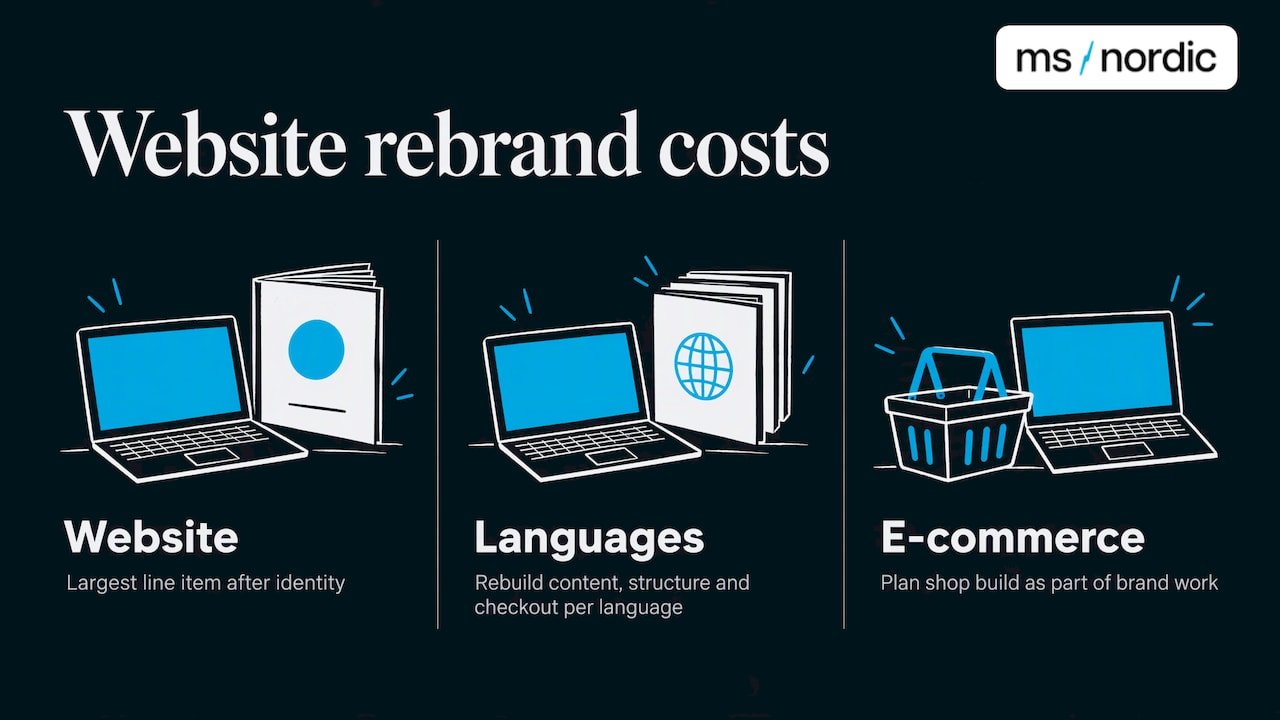
For most companies the website is the single largest line item after the identity itself. A multilingual or e-commerce site costs far more than a brochure site, because content, structure and checkout flows all need to be rebuilt in each language. If your rebrand includes a shop, plan the e-commerce build as part of the brand work, not as a separate project that starts later.
Number of markets and languages
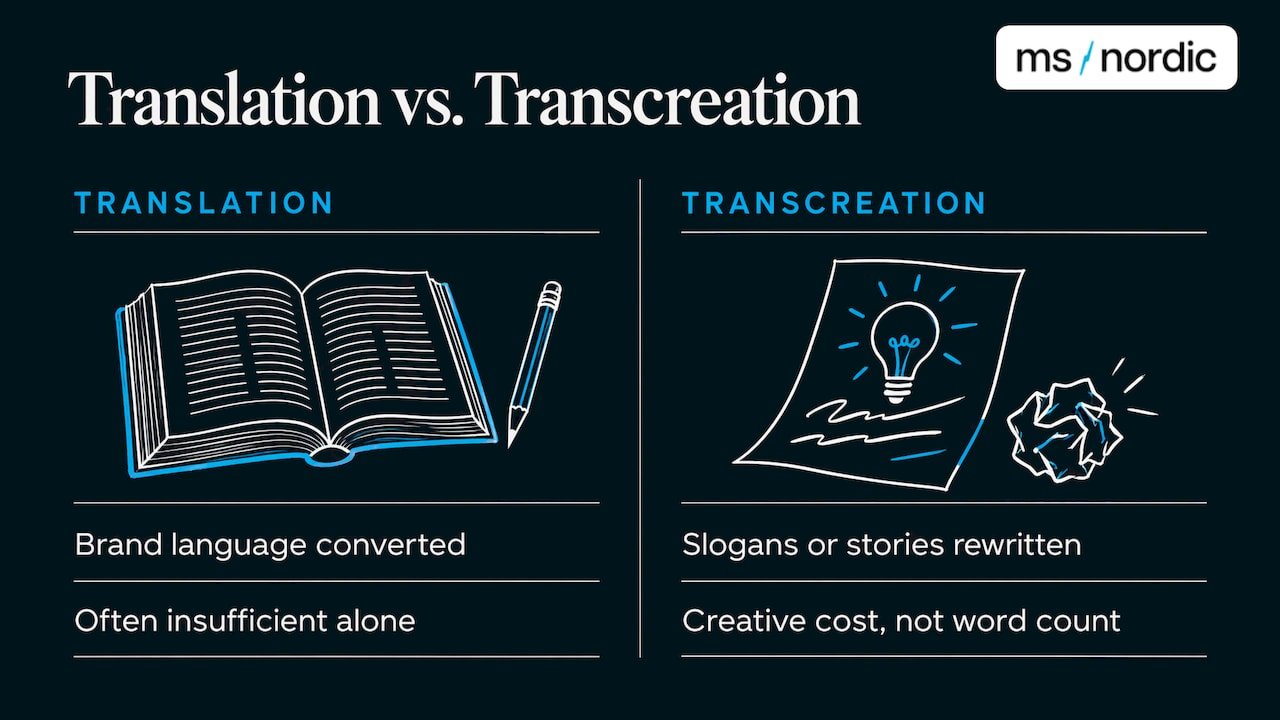
Every market you add multiplies the work: copy, imagery, legal text, payment methods, customer service. Translation alone rarely works for brand language. Our note on transcreation versus translation explains why a slogan or product story often needs rewriting, not converting, and that is a creative cost, not a word-count cost.
Who does the work
Freelancers, boutique agencies and large networks price differently. A freelancer can be the right fit for a visual refresh. A team that combines strategy, design, development and local-market knowledge is a better fit when the brand must work across borders, because one team carries the decisions through each package instead of handing them over between suppliers.
Timeline
A compressed schedule costs more, because the team cannot sequence work efficiently. A rebrand tied to a trade fair or a product launch needs to be briefed early enough that the date does not force shortcuts.
The costs most budgets miss
The quote for design is rarely the whole bill. Two sources help here. The Swiss guide warns that forgotten add-ons often make up 30% to 50% of the core rebrand budget, and cites a Swiss trade association finding that 60% of SMEs underestimate implementation costs. It puts signage and vehicle livery alone at CHF 20,000 to CHF 50,000 for SMEs with physical locations.
Frontify’s 2025 rebranding guide, updated in June 2026, lists hidden cost categories beyond design fees:
- Legal: trademark updates, international filings and contract revisions, at $5,000 to $50,000 or more.
- Technology: migrating content systems, asset libraries and product interfaces, at $50,000 to $200,000 or more for larger organisations.
- Change management and training: $10,000 to $50,000 or more.
- Ongoing governance: $20,000 to $100,000 a year at enterprise scale.
Those figures describe large organisations. A 20-person company will not meet most of them at that size, but it will meet every category in a smaller form. The sensible habit is to list the categories, then price each one for your own business.
A checklist for your own budget
- Website and landing pages, in every language you need
- Product interface, app or platform updates (a mobile app rebuilt around a new brand shows how far a rebrand can reach into product work)
- Trademark searches and registrations in each market
- Contracts, invoices, terms and privacy policies
- Signage, packaging, vehicles and uniforms
- Sales decks, brochures and exhibition materials
- Updating directory listings, partner pages and email signatures
- Staff briefing and brand guidelines
- Launch campaign and paid media
- Search visibility during the switch, particularly if domain or page names change
The last item is easy to overlook. If your web address or page structure changes, plan redirects and content updates so you keep the visibility you have built. Our guide on online visibility, SEO and AI search covers what to protect.
When the rebrand is for a new market
If you are taking an existing brand abroad, the question changes from “what does a rebrand cost?” to “how much of the brand has to change for this audience?” Sometimes the answer is very little. Sometimes the name, the claims or the visual codes do not travel.
Take a Danish company entering Spain. Beyond the design work, you should budget for:
- Language. Consumer-facing information is generally expected in Spanish, and regional language rules can apply in some contexts.
- Consumer and data rules. Price display, withdrawal rights, warranties, consent for email and messaging, and data protection all shape how pages, checkouts and campaigns are written.
- Tax and invoicing. VAT and invoicing requirements affect templates and checkout design.
- Cultural fit. Tone, humour, imagery and the way a company talks about quality differ between Copenhagen and Madrid or Barcelona.
Spend on this before launch, not after. We cover the reasoning in our guide to brand localisation and in why a Spanish launch without a localisation strategy gets expensive. Check the legal points with a Spanish lawyer for your sector before you finalise copy and contracts.
How to control the budget without weakening the result
- Write the problem down first. “We look dated” is a refresh. “Buyers in a new country do not understand what we do” is a repositioning. The two cost very differently.
- Set the scope by outcome. Decide what must be live on launch day: website, deck, packaging, campaign. Everything else goes into phase two.
- Ask for quotes on the same brief. If one quote includes strategy and the other does not, the lower number is not cheaper.
- Keep what already works. A recognisable name, colour or product line is an asset. Evolving it costs less than replacing it, and it keeps the recognition you have.
- Reserve a contingency. Because implementation is so often underestimated, hold back a share of the budget for rollout, in line with the 30% to 50% add-on warning above.
- Phase the rollout. Digital first, then print, then signage, so old stock is used up and cash flow is steady.
- Build a guidelines document. A clear set of brand rules lets your team, printers and partners produce consistent work without going back to the agency for every file.
- Brief one team across strategy, design and digital. Fewer handovers mean fewer misunderstandings and fewer rounds of revisions.
A worked example
Imagine a 15-person B2B company with a Danish brand, selling in Denmark and now entering Spain. Its budget plan might look like this:
| Item | Share of the plan |
|---|---|
| Strategy and market research | Core |
| Identity update and guidelines | Core |
| Spanish-language website | Core |
| Sales and presentation materials | Core |
| Legal checks and trademark filing | Add-on |
| Launch campaign | Add-on |
| Contingency | Add-on |
The shape matters more than the numbers. The add-on rows are where overspend happens when no one has priced them. Put a figure against each row before you sign anything, using quotes from your own providers.
What good looks like in practice
We have rebuilt brands for law, e-commerce and collaborative platforms, and the pattern repeats. The strongest projects start with strategy and carry the same thinking into the website and the materials. You can see one in our work for a law firm: Zafo Law’s brand update, website and visual identity system. Professional services firms face their own questions on trust and tone, which we set out in our guide to law firm branding. Startups can start from a practical branding strategy for founders.
Our view on rebranding budgets
Most rebrands that go over budget did not go wrong in design. They went wrong in the brief. A company asks for a new logo, then discovers it also needs a new website, new sales material and a new way of speaking to a market it has never sold in.
We start from the market. Where are you going, who are you speaking to, and what must they understand in the first ten seconds? Our strength is combining strategic insight, creative skill and cultural fluency, so the answer to those questions shapes the identity, the digital presence and the local adaptation together. Working from Barcelona and Copenhagen, we build bridges between a brand and the people it wants to reach.
A budget built on that foundation is easier to defend and easier to phase. You know what must exist on day one and what can follow.
Jacob Munch
Plan your rebrand with us
If you are entering a new market or need a market-ready identity, our Brand & Identity service covers strategy, identity and the guidelines that keep your brand consistent. We can extend it into digital presence and campaigns, so the website and launch work follow from the same brief. Our services page lists the full range, from prototyping to events and exhibitions.
Tell us the market, the scope and the date you need to launch. We will help you shape a brief you can price. Start a conversation.
FAQ
How much does it cost to rebrand a small business?
With an agency, published ranges for small and mid-sized businesses start around $10,000 to $15,000 and reach $70,000 or more, according to Shopify’s rebrand guide. Startups with a handful of staff can budget less, as in the CHF 10,000 to CHF 30,000 range in the Swiss guide. Scope decides where you land.
Why do agencies not publish fixed prices?
Because two projects labelled “rebrand” can differ by a factor of ten in work. A new market, a new name, a multilingual site or a product interface each change the effort. A fair quote follows a short discovery conversation about your goals and markets.
What costs do people forget when rebranding?
Implementation. The Swiss guide says add-ons often reach 30% to 50% of the core budget. Legal updates, signage, website migration, staff briefing and the launch campaign are the usual items.
Does rebranding for a new country cost more?
Usually, yes, because language, legal wording, local tone and channels need work. The upside is that the work happens once, inside one plan, rather than as a series of fixes after launch. Price the localisation as part of the brief.
Sources
- How much does a rebrand cost in 2026 (Pixelixe)
- How Much Does a Rebrand Cost? Small Business Rebrand Guide (Shopify)
- Was kostet ein Rebranding in der Schweiz? (Alpine Excellence)
- A complete breakdown of rebranding costs in 2025 (Frontify)
- Fractional CMO for Spain Market Entry (Old Fox)
- AppForType Mobile App case study (Requestum)