Digital campaign planning is the process of turning a business objective into a sequenced set of marketing activities. It names who you want to reach, what you want them to do, where and when you will reach them, what it costs, and how you will know it worked. A good plan fits on a few pages. A great one is something your whole team can run from without asking what the campaign is for.
Below is the framework we use and recommend: seven steps, a brief template, and a section on measuring campaigns that run in more than one market.
TL;DR
- Start with one business outcome, then write campaign objectives that ladder up to it.
- Build a one-page brief (goal, audience, core message, milestones) and name an approver for every deliverable.
- Choose channels from audience behavior, not habit, and set the budget after you know the goal.
- Plan measurement before launch. Last-click numbers alone understate what top-of-funnel activity does.
- Entering a new market? Localize the message, the offer and the tracking setup, not just the language.
Table of Contents
- What a campaign plan actually has to do
- Pick a framework, then make it yours
- The seven steps of digital campaign planning
- A one-page campaign brief you can copy
- Measurement: plan it before you launch
- Planning for a new market
- Our perspective: plan the bridge before you build the campaign
- How we can help
- FAQ
- Sources
What a campaign plan actually has to do
A plan has three jobs. It aligns people, it allocates money and time, and it defines success before anyone sees results.
That last job matters most. Teams that skip it end up judging a campaign by whatever number looks best afterward. The American Marketing Association stresses grounding decisions in research instead of assumptions, starting with a situation analysis of customer pain points and the competitive landscape, so that every objective connects to a broader business outcome.
The plan is also a team exercise. Facilitators who run campaign workshops note that the planning process is as valuable as the plan: involving key stakeholders early builds buy-in, surfaces risks and creates accountability across departments.
Pick a framework, then make it yours
You do not need to invent a structure. Several are well established, and the right one depends on your team and audience, as the AMA explains in its overview of marketing frameworks.
| Framework | What it covers | Best for |
|---|---|---|
| OASIS | Objectives, Audience, Strategy, Implementation, Scoring | Single campaigns with a clear behavior to change |
| 4 Ps | Product, Price, Place, Promotion | Checking that the offer and the promotion agree |
| 7 Ps | Adds People, Process, Physical Evidence | Service businesses, where delivery is part of the pitch |
| Seven-step strategic marketing process | Research through evaluation | Annual or multi-campaign planning |
OASIS comes from the UK Government Communication Service and is described in its guide to campaign planning. It was written for public communications, but the logic travels well. The last letter, Scoring, is the part most commercial plans leave vague.
The AMA notes that the 7 Ps add people, process and physical evidence, which matter for service-based businesses such as agencies and consultancies. If you sell a service, use the 7 Ps as a checklist alongside your campaign steps.
The seven steps of digital campaign planning
Most published guides land on a similar sequence. For instance, TeamGantt’s eight-step guide treats planning as a sequence that begins with the goal. Here is our version.
1. Set one goal and a few measurable objectives
Write the business outcome first: new qualified leads, first orders in a new region, a signed distributor. Then write two to four objectives that serve it. Each one needs a number, a date and a source for the data.
Weak: “Increase awareness.”
Stronger: “Reach 40% of our target accounts in the US Northeast with two or more touches by the end of Q2, tracked in our CRM.”
The numbers are yours to set from your own baseline. Do not borrow benchmarks you cannot trace.
2. Know your audience and your situation
Do the situation analysis before you pick a single channel. Answer these:
- Who decides, who influences and who signs off?
- What problem do they believe they have, in their own words?
- Who else is competing for their attention, and how do they position themselves?
- What do you already own: email lists, case studies, search visibility, a sales team?
Speak to customers and to your sales team. A handful of real conversations beats a persona built from assumptions.
3. Define the core message and the offer
One campaign, one core message. State the problem you solve, the proof you have and the action you want. Then test it against the 4 Ps: does the product, price, place and promotion all point the same way?
If your brand is not yet clear, fix that first. We make this argument at length in Branding Before Marketing: promotion works harder when the identity it promotes is already defined.
4. Choose channels from audience behavior
Pick channels where your audience already spends attention and where you can measure the result. A typical mix for a B2B campaign might combine:
- Paid search for people who already know the problem
- Paid social for reach and retargeting
- Email for nurturing known contacts
- Content and SEO for long-term discoverability
- Landing pages built for the one action you want
Search behavior is changing as AI answers reshape results. Our piece on the new era of online visibility covers what that means for planning.
Fewer channels, done well, beat a thin presence everywhere.
5. Set the budget and the timeline
Set the budget after the goal, not before. Split it into three buckets: media, production, and measurement (tools, tagging, analysis). Many teams fund the first two and starve the third.
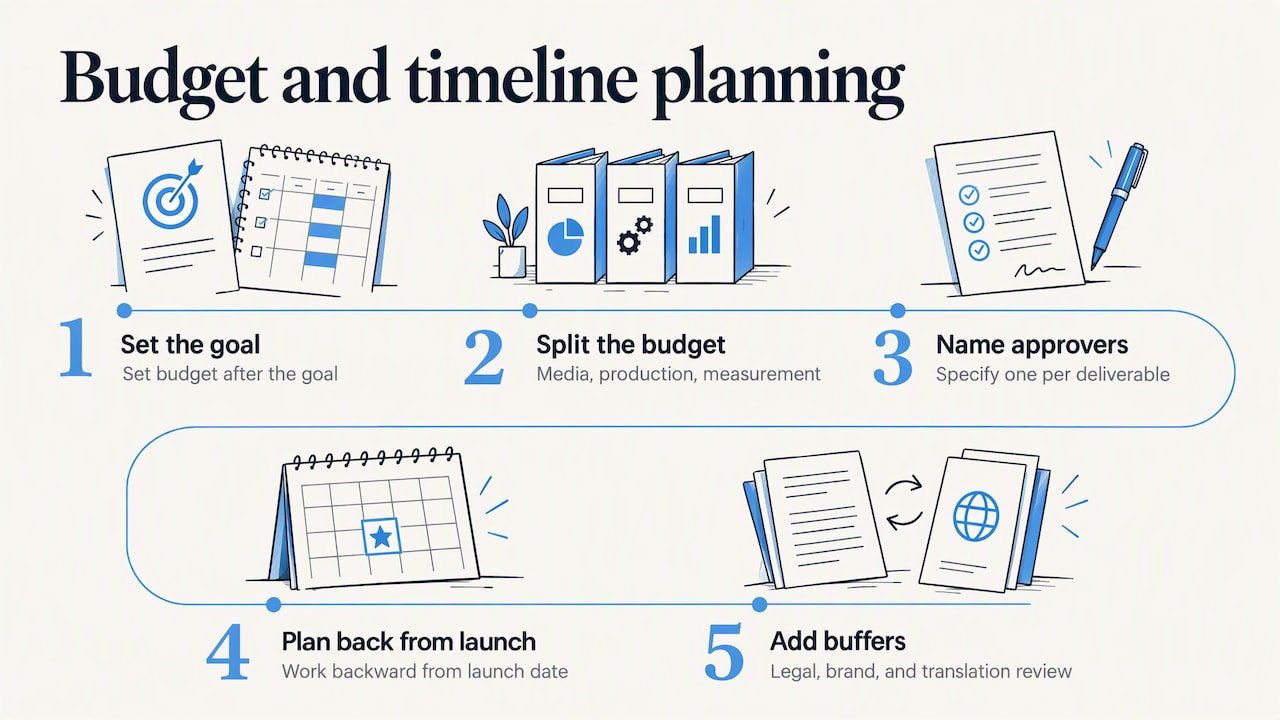
Then build the timeline backward from the launch date. TeamGantt points out that teams often underestimate internal approval cycles, and recommends documenting a specific approver for every deliverable. We agree. Add buffer for legal review, brand review and translation if you are working across languages.
6. Build the brief and assign roles
The brief is the campaign’s source of truth. The same TeamGantt guide describes the briefing stage as the most critical, capturing the goal, target audience, core message and key milestones. Use the template below.
7. Launch, measure, adjust
Launch in a way that lets you learn. Start with a short test period, check that tracking fires correctly, then scale what works. Schedule a review at fixed points, such as week two, week six and close, and decide in advance what result would make you change course.
A one-page campaign brief you can copy
| Field | What to write |
|---|---|
| Business outcome | The commercial result this campaign serves |
| Objectives | 2 to 4 measurable targets with dates |
| Audience | Roles, company types, regions, key pain points |
| Core message | One sentence the audience should remember |
| Offer and call to action | What you are asking them to do, and why now |
| Channels | Each channel, its role, its owner |
| Budget | Media, production, measurement |
| Milestones | Key dates from brief to close |
| Approvers | One named person per deliverable |
| Measurement plan | KPIs, data sources, reporting rhythm |
| Risks | What could slip, and the fallback |
Keep it to one page. If it needs two, the campaign probably has two goals.
Measurement: plan it before you launch
Measurement is where plans most often fall apart. The short version: decide what counts as success, make sure the data can actually be collected, and do not rely on a single attribution model.
Why last-click is not enough
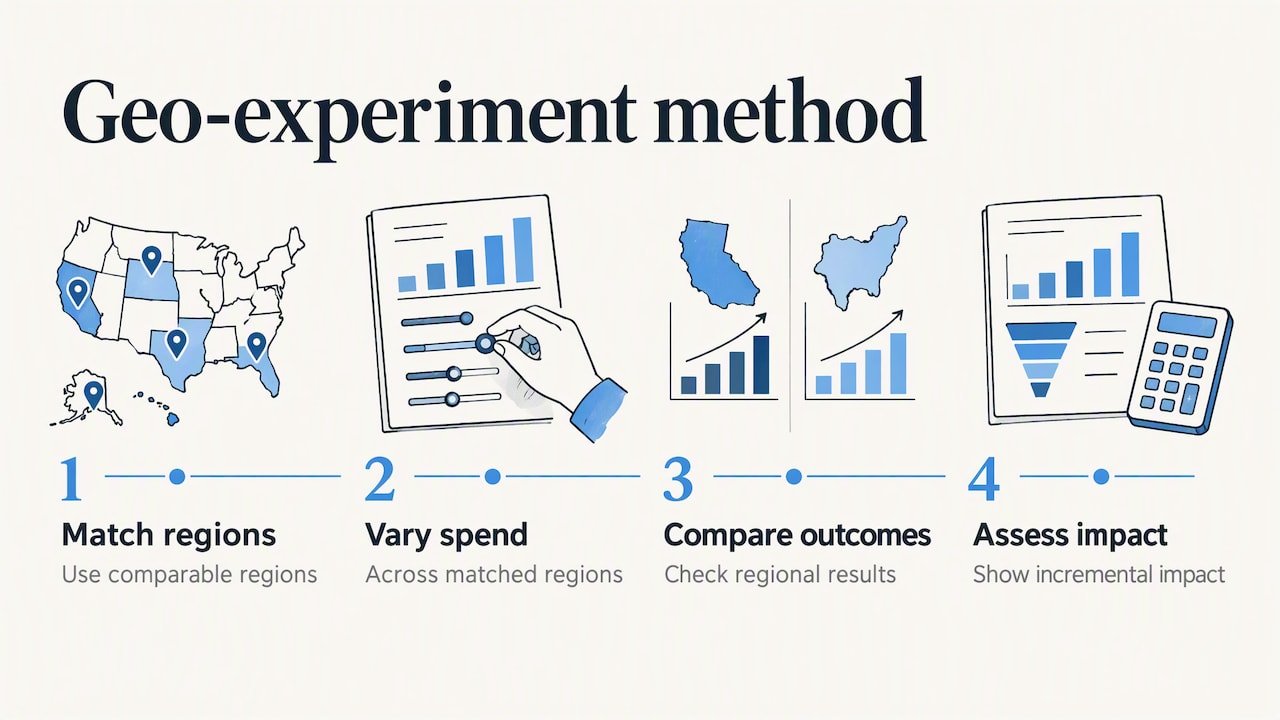
Last-click credit tends to favor the final ad someone touched. It can hide the value of earlier activity. Swarovski worked with Google to plan four geo-experiments in the USA, Canada, Great Britain and Australia to test how much generic search campaigns added. The idea is simple: vary spend across comparable regions and compare the outcomes. That shows incremental impact, not just credited conversions.
You do not need a retailer’s budget to borrow the logic. A B2B team can pause or increase activity in matched regions or account segments and compare pipeline.
Connect online and offline outcomes
Google’s measurement guidance for retail advertisers promotes a value-led approach: break down data silos, connect ad performance to outcomes beyond the click, and use that to guide budget. For a B2B services company, the equivalent is tying campaign touches to CRM stages: meeting booked, proposal sent, contract signed.
Measuring across markets
When one campaign runs in several countries, add these rules:
- Use the same KPI definitions everywhere. A “lead” in Copenhagen should mean the same as a “lead” in Chicago.
- Report in local context. Compare each market to its own baseline first, then to the others.
- Check consent and tagging per region. Google’s developer documentation notes that advertisers need to manage consent variables at the tag level, including flags for DMA compliance in EEA markets, to keep measurement accurate and compliant. Ask your legal or privacy lead to confirm requirements for each market you enter.
- Feed local data back in. Local behavior and offline conversions should inform bidding and targeting, not sit in a separate report.
Planning for a new market
A campaign that worked at home is a hypothesis abroad. Translation is the smallest part of the change. Check:
- Message: Does the core promise mean the same thing locally? Do the proof points carry weight there?
- Offer: Are pricing, shipping, payment methods and terms what local buyers expect?
- Channels: Which platforms and search habits dominate in that market?
- Visuals and tone: Do identity, imagery and humor land, or do they feel imported?
- Compliance and tracking: Are consent and data rules respected from day one?
We wrote about the cost of skipping this in our article on entering Spain without a localization strategy. The pattern repeats in any market: brands that adapt early spend less fixing things later.
Our perspective: plan the bridge before you build the campaign
We work from Barcelona and Copenhagen, and most of the campaigns we see go wrong share one trait: the plan starts at the channel. Someone picks paid social or a launch film, and the questions about who the audience is and what the brand stands for come second.
We reverse that order. Identity and positioning first, then the campaign. When a brand enters a new market, the campaign is the visible part of a longer job: making the brand relevant to people who have never heard of it, in a cultural context it did not grow up in. That is what we mean by building bridges.
Three habits make the difference in our experience:
- Write the measurement plan on day one. If you cannot say how you will score the campaign, you are not ready to brief it.
- Bring local voices into the room early. Cultural fluency is cheaper to add at the brief than at the post-mortem.
- Treat the plan as a living document. Review it on schedule and change it when the data says so.
We often collaborate with partner agencies and local specialists, and we favor measurable outcomes over impressive-looking reports.
— Jacob
How we can help
If you are planning a campaign for a new market, we can help with the strategy, the identity it depends on, and the digital work that carries it. Our Digital Presence & Campaigns service covers campaign planning and delivery, and the rest of our work is on the services page. You can also browse past advertising projects to see how we approach them. Start a conversation, and bring your brief, even if it is only half written.
FAQ
What are the steps in digital campaign planning?
Set a goal and objectives, understand your audience, define the core message and offer, choose channels, set the budget and timeline, write the brief, then launch and measure. Different guides number these differently, but the sequence is consistent. The key is that measurement is planned at the start, not added at the end.
How long does it take to plan a digital campaign?
It depends on the size of the campaign and how many people must approve it. Simple single-channel campaigns can be planned in days. Multi-market campaigns need more time for research, translation and review. Approval cycles are the most commonly underestimated part, so name approvers early.
Which framework should I use?
Use the one your team will actually follow. OASIS works well for single campaigns with a clear behavior to change. The 4 Ps help check the offer, and the 7 Ps suit service businesses. Many teams combine a framework with a one-page brief.
How do I measure a campaign that runs in several countries?
Define KPIs identically in every market, compare each market to its own baseline, and go beyond last-click attribution where you can, for example with regional experiments. Check consent and tagging requirements per region before launch, and confirm them with your legal or privacy lead.
Sources
- A Step-by-Step guide: How to Plan a Digital Marketing Campaign in 8 Steps, TeamGantt
- What Are Marketing Frameworks? American Marketing Association
- What is Strategic Marketing? American Marketing Association
- The Art of Campaign Planning, REAMP
- Swarovski examined the relevance of generic search campaigns through geo-experiments, Think with Google
- The APAC Shopping Season Playbook, Think with Google
- DDM Integration for Third-Party App Tracking, Google for Developers