The right set of international payment methods is not one global checkout. It is a short list per country: the cards and wallets everyone expects, plus the one or two local methods your new customers use every day. Shoppers in a new market judge your brand at the payment step. If they do not see a method they trust, they leave, however good your branding and product pages are.
This guide is for businesses taking a store or service into a new market: a Danish company exporting to Spain, a UK brand selling into the Nordics, a startup launching in several countries at once. It explains the types of payment method, how preferences differ across Europe, how to build a mix, and how payments fit into a market-entry plan.
TL;DR
- International methods (major cards, PayPal, Apple Pay, Google Pay) work almost everywhere. Local methods (national schemes, bank-based and mobile apps) are what many customers actually reach for at home.
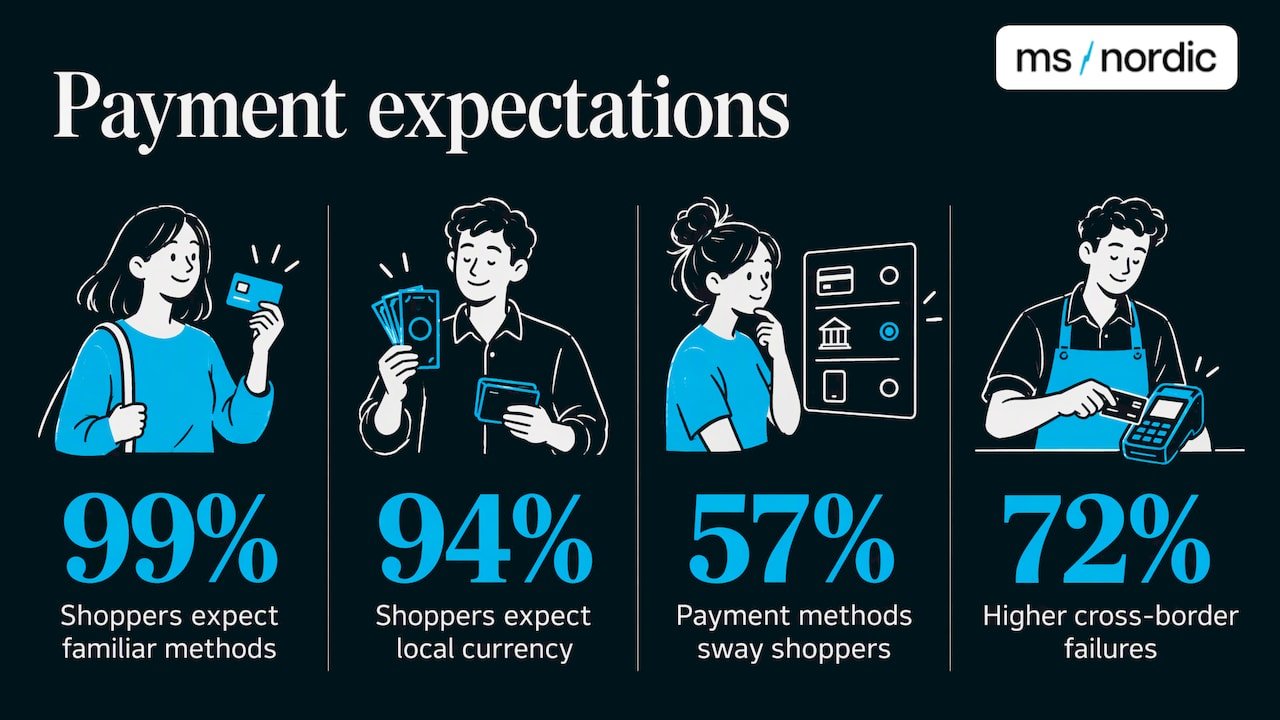
- Almost all cross-border shoppers want to pay their usual way: 99% expect their preferred methods and 57% choose retailers by the methods accepted.
- Europe is not one market. Cash, cards, wallets and bank payments carry very different weight from country to country.
- Build the mix per market: a global base, then one or two local methods, then check cost, settlement time and currency.
- Payment choices are part of localisation. Treat them as a brand and checkout decision, not a late technical task.
Table of Contents
- International, local and alternative: what the terms mean
- Why the mix matters for conversion
- What Europeans actually use
- How to choose your mix: five steps
- Business-to-business payments across borders
- Payments are part of localisation
- Perspective
- Where we help
- Common mistakes when selling across borders
- FAQ
- Sources
International, local and alternative: what the terms mean
The terms overlap, so it helps to fix them early.
- International (global) methods are the ones that work in most countries and currencies: Visa and Mastercard cards, PayPal, Apple Pay and Google Pay.
- Local payment methods are the ones that dominate one country or region: a national card scheme, a bank-transfer system, a mobile app or, in some places, cash-based vouchers. Examples are iDEAL in the Netherlands, BLIK in Poland, MobilePay in Denmark and Finland, Swish in Sweden, and Bizum in Spain.
- Alternative payment methods is the umbrella term for anything that is not a major card: wallets, bank transfers, direct debits, buy now pay later and vouchers. Every local method is alternative, but not every alternative method is local.
When search results talk about “payment methods in Europe” or “preferred payment methods by country”, they are describing this gap. Global methods get you in the door. Local methods make the checkout feel native.
Why the mix matters for conversion
The evidence points the same way. Research on cross-border commerce reported by PYMNTS found that 99% of cross-border shoppers expect to pay with their customary methods and 94% in their local currency. The same research found that 57% of shoppers pick a retailer based on the payment methods it accepts, and 72% of merchants see higher failed-payment rates on cross-border transactions.
The long-term direction is also clear. Digital wallets already make up more than half of global e-commerce payment transactions, with a forecast of 63% by 2030, according to Statista’s regional data. The same data shows how uneven that is: wallets account for over 75% of e-commerce payments in Asia-Pacific, but a much lower share in Latin America and the Middle East and Africa.
The takeaway for an exporter: a method that is the default in one market may be almost irrelevant in the next. Copying the checkout from your home site is the most common and most expensive shortcut.
What Europeans actually use
Europe is where most UK, Danish and Nordic exporters start, and it is the market with the widest spread of habits.
Online: cards lead, wallets follow
The European Central Bank’s 2024 survey of euro-area consumers found that cards were the most used online payment instrument, at 48% of online transactions, with e-payment solutions such as wallets and mobile apps at 29%. Online payments were 21% of consumers’ day-to-day payments by number, and 36% by value. So cards are a safe base, but nearly a third of online payments already sit with something else.
In person: habits differ sharply
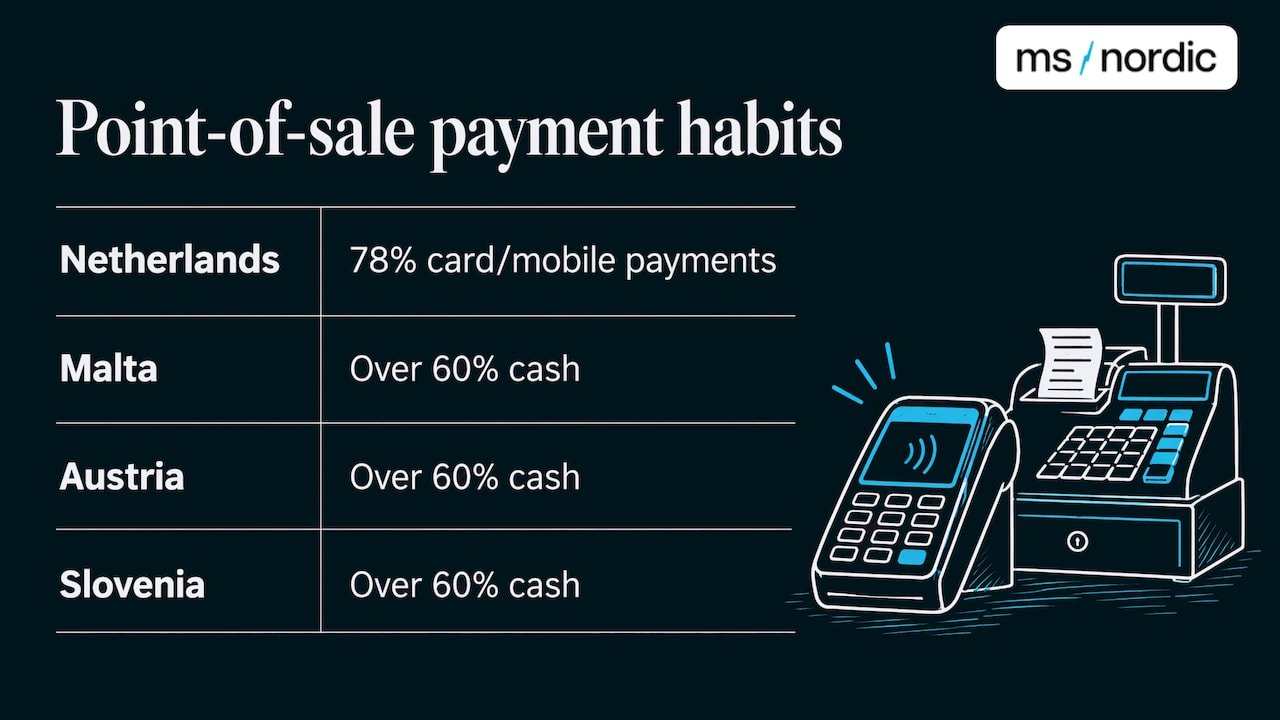
If you also sell at events, pop-ups or through retail partners, note that the euro area is not uniform. European Commission open data shows the Netherlands leads on non-cash point-of-sale payments, with 78% of payments by card or mobile app, while cash still accounts for more than 60% of transactions in Malta, Austria and Slovenia.
A 2026 BearingPoint survey adds that contactless card payments are the most widely used method across Europe, at an average of 71% of respondents, with Finland highest at 84% and the Netherlands and Denmark at 74%. Instant payments are used regularly or occasionally by about half of eurozone respondents.
A quick country view for exporters
Use this as a starting point for research, not a final answer. Market shares change, so check current figures for the country you are entering before you commit.
| Market | Methods worth investigating | Why it matters |
|---|---|---|
| Denmark | Cards, MobilePay | Danish shoppers expect their national wallet alongside cards |
| Spain | Cards, Bizum, wallets | A domestic mobile payment app sits next to card habits |
| Netherlands | iDEAL (bank payment), cards | Bank-based payments are central to Dutch online shopping |
| Germany | PayPal, invoice, bank-based methods | Cards are not the default for many German shoppers |
| Sweden and Finland | Swish, MobilePay, bank e-payments, Klarna | Domestic wallets and bank methods are familiar and trusted |
| UK | Cards, Apple Pay, Google Pay | High card use, with wallets increasingly common |
For Danish companies exporting to Spain, the lesson is direct. MobilePay, which your home customers expect, does not travel. A Spanish customer will look for cards, wallets and the local mobile option they use with friends and family. It is the same exercise in reverse for a Spanish brand entering Denmark.
How to choose your mix: five steps
You do not need to accept everything. You need the right few methods, in the right order, for each market.
1. Start with the customer, not the provider
List the two or three markets you will launch in. For each one, find out how your target customers pay online today. Use official surveys (central banks and the European Commission publish them), your own analytics from existing foreign visitors, and local colleagues or partners. Segment by age and device: a mobile-first audience behaves differently from a desktop B2B buyer.
2. Lay a global base
Every checkout should carry the major cards and the main wallets for your audience. These cover first-time buyers who are unfamiliar with local options and tourists or expatriates in the market.
3. Add one or two local methods per market
In most markets a small number of methods cover most consumer preference. Adding more has diminishing returns and adds reconciliation and support work. Pick the leading local bank-based method or mobile app, and add buy now pay later only if your average order value or your category makes instalments natural.
4. Test cost, speed and currency
Cross-border payments can be slow and costly. The ECB notes that costs exceed 3% in nearly a quarter of global payment corridors, and a third of retail cross-border payments took more than one business day to settle in 2024. For a business, this means looking at three things for each method:
- fees per transaction and any currency conversion margin;
- how long until funds reach your account;
- whether the customer sees prices and pays in their own currency.
Pricing in local currency matters, as the PYMNTS research above shows: 94% of cross-border shoppers want it.
5. Measure, then adjust
Launch, then watch where customers drop off. Track completion by country and by payment method, so you can see whether a missing method or a failed payment is the cause. A revenue and conversion tool such as revenue and conversion analytics can attribute revenue to channels and pages, and it connects with Stripe and Shopify data, which helps when you are comparing markets.
Business-to-business payments across borders
If you sell to companies rather than consumers, the picture shifts towards bank transfers, invoices and credit terms. Inside the euro area and for euro payments, SEPA transfers are standard and usually inexpensive. Outside SEPA, SWIFT payments cost more and can take longer; the ECB cites a Croatian small business paying up to 12 times more to send €5,000 outside SEPA than to a SEPA counterpart. For recurring B2B customers, agree the currency, the payment terms and who bears the transfer fees in the contract before the first invoice.
Payments are part of localisation
Payment methods are one signal among many that tell a customer a brand belongs in their market. The others are language, tone, imagery, delivery promises, returns policy and legal information. A checkout that shows the right logos, in the right language and currency, reads as familiar. One that looks imported reads as risky, especially for a brand nobody in that country has heard of yet.
That is why we treat the checkout as part of the market-entry brief, not as a back-office setting. If you are selling through a store, our guide to Shopify internationalisation covers markets, languages and currencies. For Spain specifically, localisation strategy before you launch explains why a direct translation of your home presence falls short.
A practical sequence for a new market looks like this:
- Define the market and the customer you are entering for.
- Localise the brand and messaging.
- Set up the store, currency and delivery promise.
- Add the payment mix for that country.
- Launch, measure and refine.
Skipping step 4 or leaving it until the end is where most stores lose early sales.
Perspective
When a brand enters a new country, customers do not separate “brand” from “checkout”. They meet one experience. If the identity says “made for you” and the payment step says “foreign shop”, the promise breaks at the moment that matters most.
That is how we approach expansion from Barcelona and Copenhagen. Strategic insight tells you which market and which customer. Cultural fluency tells you how that customer expects to buy. Creative and digital work turns both into a store and a brand that feel local from the first click.
Our advice to founders and marketing managers is simple. Decide the payment mix as part of the market-entry plan, per country, alongside language, tone and delivery. Do it before the design and build, so the checkout is designed around real habits rather than patched afterwards.
Jacob Munch
Where we help
If you are planning a launch in Spain, the UK or the Nordics, we work with you on the brand, the store and the localisation behind it. Our E-Commerce service covers e-commerce development for businesses entering new markets, and our market-entry and localisation work starts from how your future customers actually behave.
To see the full range of what we do, from brand and identity to digital campaigns, visit our services page and start a conversation about your next market.
Common mistakes when selling across borders
- Copying the home checkout. What works in Denmark or the UK may not match Spanish or German habits.
- Offering too many methods. More logos do not mean more sales. Each method adds fees, reconciliation and support.
- Ignoring currency. Prices in the wrong currency add friction and doubt.
- Treating failed payments as bad luck. Higher failure rates on cross-border card payments are common, so watch them by country.
- Planning payments last. The checkout should be designed with the rest of the market-entry work, not added just before launch.
FAQ
What are the most common international payment methods?
Major credit and debit cards, PayPal, Apple Pay and Google Pay work in most countries. For business-to-business sales, bank transfers (SEPA within the euro area, SWIFT beyond it) are the standard. They are your base layer, to which you add local methods per market.
What is the difference between local and alternative payment methods?
Alternative payment methods are everything that is not a major card, including wallets, bank transfers and buy now pay later. Local methods are the ones that dominate a particular country, such as iDEAL in the Netherlands or MobilePay in Denmark. Every local method is alternative, but not every alternative method is local.
Which payment methods are most used in Europe?
Cards lead online across the euro area, with 48% of online transactions, followed by wallets and mobile apps at 29%. Beyond that, preferences differ by country: bank-based methods in the Netherlands, PayPal and invoices in Germany, and domestic wallets in the Nordics.
How many payment methods should I offer in a new market?
Start with a global base of cards and the main wallets, then add one or two local methods for that country. Review the results after launch by country and method, and add another only when the data shows customers are missing it.
Sources
- PYMNTS: Almost all cross-border shoppers want to pay with local currency
- Statista: E-commerce payment methods share, by region
- European Central Bank: Study on the payment attitudes of consumers in the euro area 2024
- European Commission open data: The shift to digital payments
- BearingPoint: Europe’s payment system is becoming digital and mobile
- European Central Bank: Enhancing cross-border payments in Europe and beyond
- Cromojo: revenue and conversion analytics