A startup branding strategy is a set of decisions made in a fixed order: who you serve, what you argue, how you say it, and only then how it looks. Skip a step and you pay for it later in marketing spend, rework and lost trust. This guide walks through that order, the traps that cost founders the most, and what changes when your first customers are in another country.
TL;DR
- Build in this order: positioning, messaging, identity, design. A logo is the last output, not the first task.
- Consistency pays. In a 2025 survey of 200 consumers, 68% reported higher trust in startups with professional, coherent branding.
- Clear your name and mark in every target market before you commit budget. Trademark rights are territorial.
- Going abroad? Keep a few global brand pillars and adapt the story locally.
- Write the brand down as a short, usable system your whole team can apply.
Table of Contents
- What startup branding actually is
- Why it matters early
- The startup branding process, step by step
- Branding on a small budget
- Clear your name before you commit
- Going international: global pillars, local story
- Perspective: what we see in startup brands
- How we can help
- A checklist before you launch
- Common mistakes
- FAQ
- Sources
What startup branding actually is
Most founders hear “branding” and picture a logo and a color palette. That is the visible tip. A brand is the set of associations a market holds about you, and those associations compound. Practitioners describe the payoff as pricing power and an easier time hiring, which is why the work is worth doing before you scale.
For a startup, there is an extra pressure. You have no history, no reviews and often no big budget. Your brand has to carry credibility that your track record cannot yet supply. That is a job for strategy, not decoration.
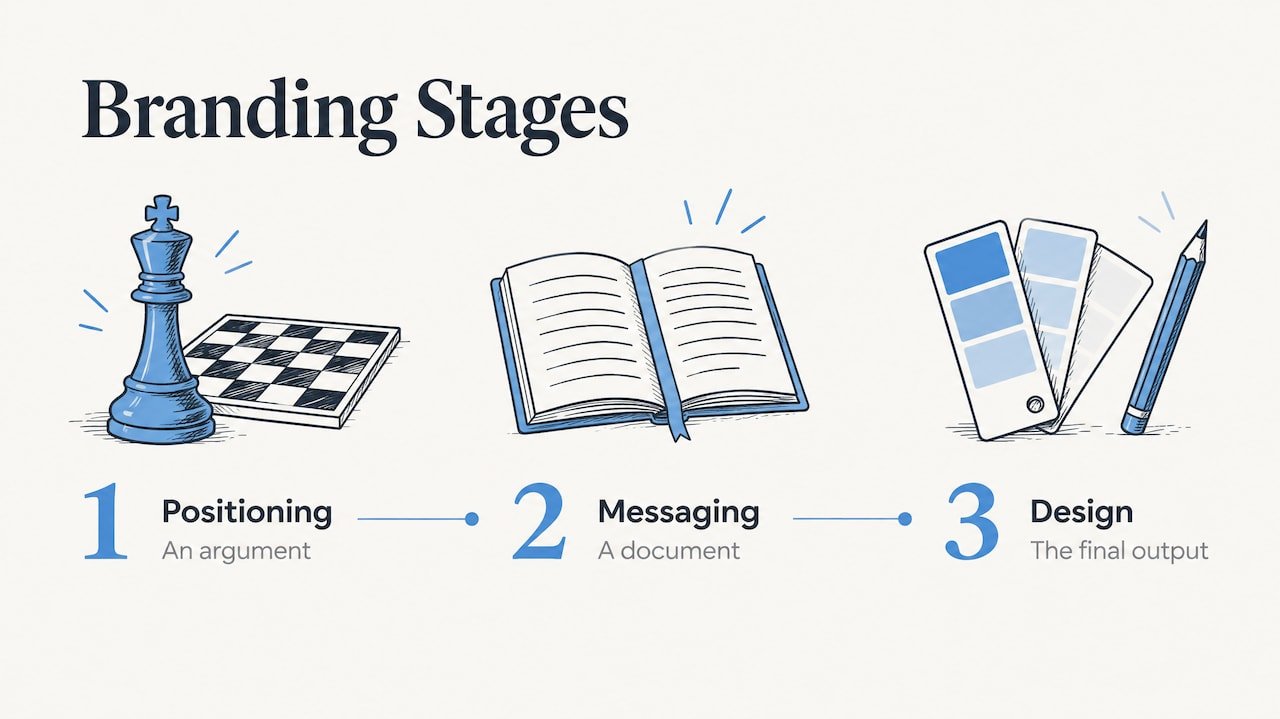
The same playbook gives a useful rule of thumb: positioning is an argument, messaging is a document, and design is the final output. Work in any other order and you end up designing something you cannot explain.
Why it matters early
The numbers are modest in sample size but consistent in direction. The 2025 study mentioned above surveyed 200 consumers across technology, fashion, food and wellness. It found that 75% prefer brands with a clear visual identity, and 60% value brands that share their personal values. Treat it as a signal, not a law of nature.
Trust also travels through people rather than ads. Nielsen’s global survey of more than 28,000 respondents in 56 countries found that 92% of consumers trust recommendations from friends and family. The data is from 2012, so read it as a long-standing pattern. A brand that people can describe clearly to a friend is a brand that gets recommended.
The startup branding process, step by step
1. Define the position
Positioning answers four questions in plain words:
- Who is this for, specifically?
- What problem do they have that you solve better than the alternatives?
- Why should they believe you?
- What do you refuse to be?
If you cannot write the answer in two sentences, the brand is not ready for design. Talk to ten target customers before you decide. Their words often beat yours.
A common pitfall is skipping this step and rebranding repeatedly. Practitioners warn that rebranding too often can mean spending many times more on marketing to get the same recall. Stability is an asset.
2. Write the messaging
Messaging turns the position into language you can reuse:
- A one-line description of what you do.
- Three proof points, each backed by something real: a number, a customer, a result.
- A voice guide: how you sound, with examples of what you would and would not say.
- A name and tagline only if they earn their place. A short, descriptive line beats a clever one.
Keep it to a few pages. A long brand bible nobody opens does nothing.
3. Build the identity
Now you design. A startup brand identity usually needs:
- A name and wordmark or logo that works at small sizes.
- A color palette and typography with clear rules.
- One or two distinctive elements, such as a shape, pattern or illustration style, that make you recognizable at a glance.
- Templates for the places customers meet you first: website, deck, social profiles, packaging.
Be wary of over-investing in the logo. We have written about why the logo is a small detail in a bigger picture: it matters, but it only works when the system around it is clear.
4. Put it into the product and the website
Your first real brand moment is rarely an ad. It is your homepage, your onboarding emails and your sales deck. Make sure each of them says the same thing in the same voice. If you sell online, the store itself is the brand. Our e-commerce work for Smukmund joined branding, strategy, design and development in one project for that reason.
5. Keep it alive
Branding is not a linear project with an end date. Academic work on startup branding describes it as an active assemblage of professional and material activities shaped by network interactions. In practice: review the brand every six months, note where customers describe you differently than you intended, and adjust the messaging before you touch the design.
Branding on a small budget
You do not need everything at once. A sensible order of spending:
| Stage | Spend on | Hold off on |
|---|---|---|
| Pre-launch | Positioning, messaging, name check, simple identity | Large campaigns, merchandise |
| Launch | Website, sales deck, core templates | Complex brand guidelines |
| Early traction | Brand system, content, customer stories | Full rebrand |
| Scaling | Localization, campaign work, deeper guidelines | Ad hoc design by many hands |
Research on early-stage ventures also points to something free: for “born global” startups, brand strength often rests on the founder’s knowledge and personal network, because tangible resources are scarce. Your story and your relationships are brand assets. A founder who has thought about how a company’s origins connect to its growth tends to explain the business more convincingly.
Clear your name before you commit
This is the step that founders skip and regret. Trademark rights are territorial. A name that is free at home can be unusable abroad if someone already holds it. Trademark clearance means confirming a proposed name is available for use and registration before you spend money and goodwill on it, usually starting with a quick knockout search and moving to deeper checks.
If you plan to expand, think about it from day one. The WIPO Madrid System lets you file for protection in several countries through one application, and the USPTO’s Madrid overview explains how US applicants can use it. But a single filing does not replace local checks. WIPO’s own case study of a global beauty company describes the system as a tool for keeping brand consistency across markets, not a shortcut around clearance.
For anything beyond a basic knockout search, talk to a trademark attorney in each target country. This is legal advice, not a design task.
Going international: global pillars, local story
If your startup is aiming at more than one market, branding gets a second layer. Localization is not translation. It is local relevance.
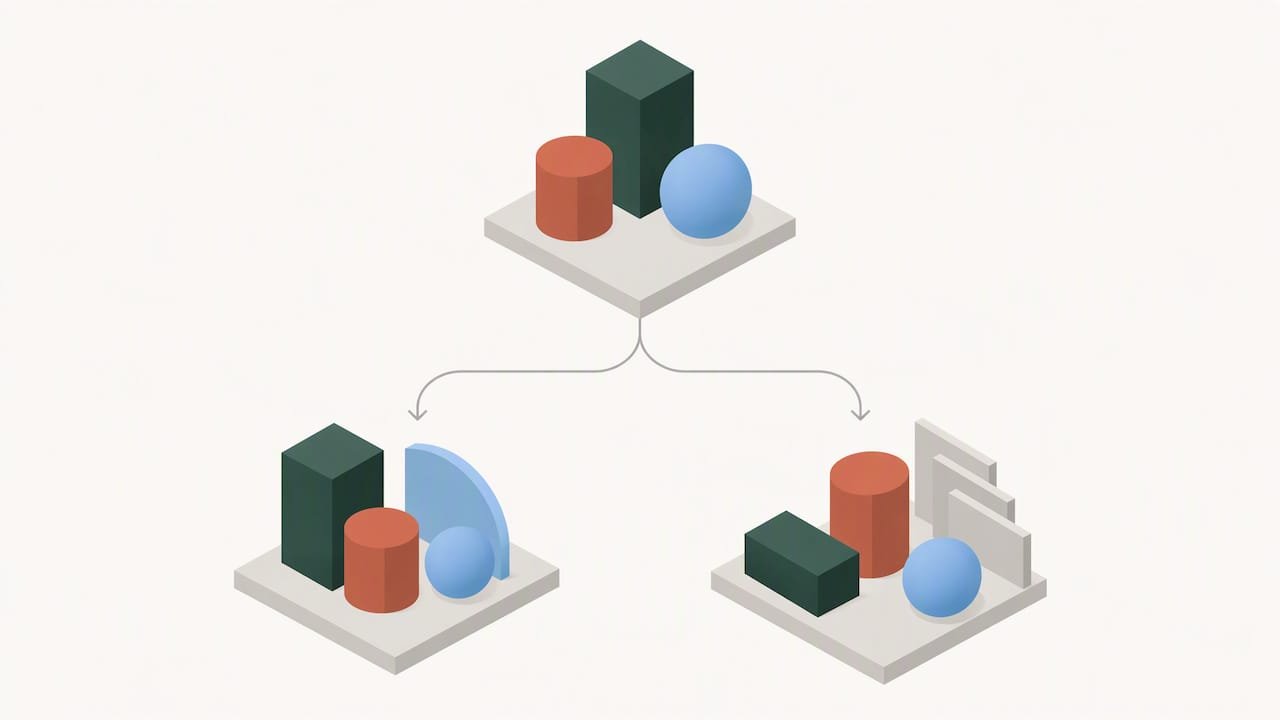
The approach that works is “global but local”. Decide which pillars never change, such as your promise, your core visual identity and your values. Then decide what adapts: tone, examples, imagery, offers, even product emphasis. One practitioner example is Airbnb in Japan, where the launch drew on the local idea of omotenashi, a spirit of selfless hospitality, to build trust.
A simple way to decide is a two-column list:
- Keep consistent: name, promise, logo, color system, product quality cues.
- Adapt locally: language and humor, social proof, price presentation, channels, legal and trust signals.
Positioning also is not permanent. A product that succeeds in one country does not automatically succeed in the next, and positioning may need to change as market needs evolve.
If Spain is on your list, we have laid out why entering Spain without a localization strategy is expensive and what a culturally specific brand language means for your entry.
Perspective: what we see in startup brands
We work from Barcelona and Copenhagen, and the same pattern shows up in the projects that go well. The founders who get the most from branding treat it as a business decision, not an art project. They agree on the position first, then design.
The second pattern: the strongest brands feel specific. They sound like a real company talking to a real customer. When a startup enters a new market, that specificity is what gets lost first. Translated copy and a copied playbook feel generic, and customers notice.
That is why we combine strategy, creative craft and cultural fluency in one process. It is also why we think of branding as building bridges: between a founder’s idea and a customer’s life, and between one market and the next. Our advice to any founder is simple. Write down what you stand for. Test it with customers. Then make it visible.
— Jacob
How we can help
If you are a founder or marketing lead who needs a market-ready identity, we can take you from positioning to a working brand system. Our Brand & Identity service covers strategy and identity design, and we pair it with digital presence, e-commerce and prototyping when you need to launch fast. See our full range of services, or look at past branding and strategy projects.
Start a conversation with us about your launch or your next market.
A checklist before you launch
Run through this before you spend on media:
- Can you state your position in two sentences?
- Have ten target customers confirmed that the problem is real?
- Is the messaging written down, with proof points?
- Have you cleared the name in your launch markets?
- Do your site, deck and social profiles look and sound like one company?
- Do you know what will stay global and what will adapt?
- Is your digital foundation ready? A coherent brand needs a clear digital presence that matches the story.
If you can answer yes to most of these, you are ready to market. Strategy-led teams also tend to treat marketing tools as support for the brand, a point covered in this look at branding through digital marketing.
Common mistakes
- Designing first. A logo without a position is decoration.
- Copying a competitor’s look. Parity in a crowded category means the brand is the tiebreaker, so sameness costs you.
- Treating the brand as a monologue. Experts advise scaling startups to keep two-way communication with customers and stay adaptable, rather than broadcasting a fixed message.
- Ignoring trademarks abroad. A blocked name means a forced rebrand at the worst time.
- Changing everything too often. Evolve the messaging; protect the core identity.
FAQ
How much should a startup spend on branding?
There is no fixed percentage. Spend first on positioning, messaging and a simple, consistent identity, and delay larger campaigns until you have traction. The right amount depends on your market, your funding and how much your brand has to carry before you have a track record.
How long does it take to build a startup brand?
The core work of positioning, messaging and identity can be done in weeks, depending on how quickly you can talk to customers and make decisions. The brand itself keeps developing as the market’s associations with you grow. Plan regular reviews rather than one big launch.
Should I design the logo first?
No. Define your position and messaging first, then design. A logo made before you know what you stand for tends to be redone, and rebranding often costs more than doing it in the right order.
Do I need to localize my brand when I enter a new country?
Yes, in most cases. Keep your global pillars, then adapt the story, tone and trust signals to local culture. Also run a trademark clearance in the new country before you commit, since rights are territorial.
Sources
- Startup brand and consumer trust survey (Dialnet, 2025)
- Global trust in advertising and brand messages (Nielsen)
- The Startup Brand Playbook
- Startup branding as assemblage (Taylor & Francis)
- How to conduct a comprehensive trademark clearance search (MC Law)
- WIPO Madrid flyer (USPTO)
- APR’s global trademark strategy (WIPO)
- Asian-Pacific expansion (Segment)
- Global product growth best practices (PMMHIVE)