
Translation renders what your text says. Transcreation recreates what your text does. If the words must be exact, as in contracts, manuals or safety information, you need translation. If the words must persuade, amuse or move people, as in slogans, campaigns and brand storytelling, you need transcreation. Most expanding brands need both, and the skill is knowing which content belongs where.
This guide explains the difference in plain terms, shows how localisation fits in, walks through the transcreation process and gives you a simple way to sort your content before you brief anyone. It is written for marketing managers, founders and decision makers taking a brand into a new market, including Danish companies heading to Spain.
TL;DR
- Translation conveys the original meaning as accurately and clearly as possible. Use it where precision matters most.
- Transcreation recreates a message in another language while keeping its purpose, tone and intended impact. Use it for slogans, campaigns, humour, wordplay and emotional copy.
- Localisation adapts content for a particular country, region or group of users, and sits between the two.
- Transcreation takes more time and costs more, so reserve it for content that carries real weight for your reputation or sales.
- A strong brief is what makes transcreation work: purpose, audience, tone, desired response and brand values.
Table of Contents
- What is the difference between transcreation and translation?
- When translation is the right choice
- When transcreation earns its cost
- Transcreation in advertising
- How the transcreation process works
- Who does the work: the transcreator’s role
- Where localisation fits
- Adapting for Spain: a note for Danish and Nordic brands
- How to decide: a five-question checklist
- Our perspective
- Taking your brand into a new market with us
- FAQ
- Sources
What is the difference between transcreation and translation?
The clearest working definitions come from the Chartered Institute of Linguists. In its guidance on translation, localisation and transcreation, translation conveys the original meaning as accurately and clearly as possible. Localisation adapts content for a particular country, region or group of users. Transcreation recreates a message in another language while preserving its purpose, tone and intended impact.
The word itself blends “translation” and “creation”, and that is a fair summary of the job. A translator asks: what does this say? A transcreator asks: what is this meant to make the reader think, feel or do, and how do I get the same result in a different culture?
Here is the difference side by side.
| Translation | Localisation | Transcreation | |
|---|---|---|---|
| Main question | What does the text say? | What does this market expect? | What should the text achieve? |
| Priority | Accuracy and clarity | Fit for a country, region or user group | Purpose, tone and impact |
| Typical content | Legal documents, manuals, public information | Websites, apps, product pages, formats and units | Slogans, campaigns, social posts, brand copy |
| Relationship to source | Close | Adapted | Free, guided by a brief |
| Time and cost | Lowest | Middle | Highest |
The split is not always clean. Research on defining transcreation points out that the balance of linguistic translation, cultural adaptation and re-creation depends on the text, the brief, the audience and the purpose. Think of a spectrum, not three separate boxes.
A simple example
Take a tagline built on a pun in English. A faithful translation will give you accurate words and no pun. The reader in Madrid understands the sentence but feels nothing. A transcreator will set the pun aside, keep the intent (say, a playful promise of ease) and build a new line in Spanish that delivers the same feeling, possibly with a different image altogether. The result may share almost no words with the original, and that is the point.
When translation is the right choice
Do not use transcreation everywhere. Translation is the better tool when precision matters. The CIOL lists legal and official documents, technical instructions, academic and scientific writing, public information, and health and safety material as areas where translation is particularly important.
In practice, for a business entering a new market that means:
- Terms and conditions, privacy notices and contracts
- Product specifications and user manuals
- Safety and compliance information
- Technical documentation and data sheets
- Internal policies and HR documents
Creative freedom is a risk in these documents. A clever rewrite of a warranty clause is a liability. Here you want a qualified translator, a second pair of eyes for review, and consistent terminology.
When transcreation earns its cost
Transcreation is particularly relevant to advertising, brand slogans and social media campaigns, as well as creative content involving humour, wordplay or emotion. The Institute of Translation and Interpreting adds that businesses may need it for marketing or communications materials with a major impact on reputation or sales, especially where cultural and linguistic differences mean translation will not be enough.
Be realistic about the trade-off. Microsoft’s localisation guidance notes that transcreation takes more time and is more costly than other forms of localisation. That is why it pays to be selective.
Content that usually deserves transcreation
- Brand taglines and campaign headlines
- Video scripts and voiceovers
- Social media campaigns and creator briefs
- Homepage and landing page hero copy
- Brand names, product names and claims
- Launch announcements and brand stories
- Email and ad copy where tone drives the click
Content where it is overkill
- Order confirmations and system messages
- Spec sheets and FAQs of a purely factual kind
- Internal documents
A useful test: if a literal version of this line would land flat, confuse or offend, transcreate it. If a literal version would be perfectly good, translate it.
Transcreation in advertising
Advertising is where the gap between the two disciplines shows fastest. Ads compress meaning into a few words and rely on rhythm, double meanings, cultural references and emotion. Those are exactly the things that do not travel word for word.
Academic work on the subject describes how global campaigns may be transcreated by centralised implementation agencies relying on freelance in-market copywriters and translators. The same research cites Claudia Benetello’s view that transcreation is the only effective way to handle marketing and advertising content, because it lets the text work as if it had originated entirely within the target culture. You do not have to agree that it is the only way to see the logic: an ad that reads as native persuades better than one that reads as imported.
For campaign teams this has practical consequences:
- Brief the concept, not just the copy. Share the strategy, the audience insight and the emotional goal, so the transcreator can solve the problem instead of converting sentences.
- Plan for different lengths. A recreated line may be shorter or longer, which affects layouts, video timing and character limits in ads.
- Check images and copy together. Visuals carry cultural meaning too. A line that works in one market can clash with the picture beside it in another.
- Align with channel targeting. Creative adapted for a market works best when your audience settings match it. Our guide to geo targeting ads covers how to set that up without wasting budget.
If you are planning a wider rollout, our step-by-step digital campaign planning framework shows where adaptation fits in the campaign timeline.
How the transcreation process works
Good transcreation is a structured process. According to the ITI, it typically involves a client brief, a draft translation, brainstorming of several options, possible back translations, and usually two rounds of revision based on client feedback.
Step 1: The brief
Everything starts here. The ITI says transcreation is carried out from a client brief specifying the text’s purpose, target audience, tone, desired response, brand values, media, format and images. If you cannot answer those points, you are not ready to brief.
A useful brief includes:
- What the piece is for, and the single action you want
- Who the audience is, in specific terms
- Tone of voice, with examples of copy you like and dislike
- Brand values and words you never use
- Where it will appear and in what format
- Any visuals that accompany it
Step 2: Draft and options
The transcreator starts from a draft translation to understand the source, then develops several creative routes. You receive options, often with a short explanation of the thinking behind each.
Step 3: Back translation
Because you may not read the target language, a back translation renders the new line into your language so you can judge its logic. Treat it as a guide to meaning, not a verdict on quality. A good transcreation will often look quite different when back translated, which is normal.
Step 4: Revision and sign-off
Expect around two rounds of feedback. Give reasons, not just preferences. “The tone feels too formal for our audience” helps. “I do not like it” does not.
Step 5: Test where you can
If a line is going to anchor a campaign, run it past a small group of native speakers in your target audience, or test variants in a small paid campaign before committing the full budget.
Who does the work: the transcreator’s role
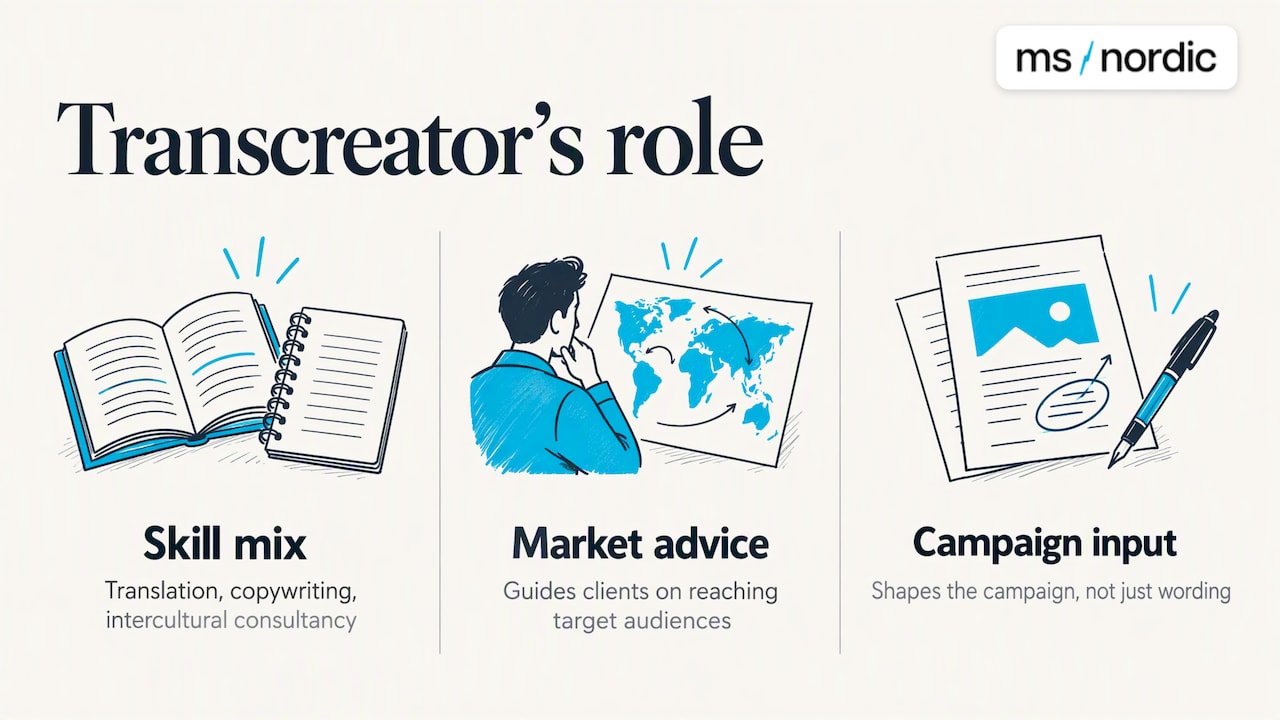
Transcreation draws on several skills at once. The ITI’s code of practice describes it as a combination of translation, copywriting and intercultural consultancy, calling for intercultural awareness, interlinguistic skills and marketing acumen.
That consultancy element matters. The ITI notes that transcreators can act as consultants, advising clients on how best to reach their target audience and clarifying doubts about the work. Use that. Ask your transcreator what will and will not work in the market, and let the answer shape the campaign, not just the wording. Copy that persuades in any setting is built on the same principle: knowing the audience first. The thinking behind event page copywriting shows how much audience insight shapes the words that sell.
Where localisation fits
Localisation is the layer that makes your whole experience feel at home in a market: currencies, date formats, units, imagery, payment methods, legal references and tone. Transcreation can be one part of it, applied to the creative pieces. Translation can be another, applied to the factual ones.
For teams publishing across many regions, a consistent process is what stops quality drifting. Approaches to multi-location content automation can help with scale, but the brand-defining lines still need human creative judgement.
For the wider picture, read our guide to brand localisation and how to adapt your brand for a new market.
Adapting for Spain: a note for Danish and Nordic brands
Nordic brands often rely on understatement, directness and clean, minimal messaging. Those strengths can read differently elsewhere. The ITI’s material on transcreation observes that Spanish audiences generally prefer a less pushy, more relationship-oriented approach than some other markets, and that an affinity for familiar brands is a nuance worth understanding when adapting content for Spain. Treat this as a starting point for your research, not a rule: audiences in Spain vary by age, region and sector.
What that means in practice:
- Warmth over efficiency. Copy that feels brisk in Copenhagen may feel cold in Madrid or Barcelona.
- Build trust before the ask. Show who you are before pushing the offer, with testimonials, familiar partners and a clear story.
- Mind regional context. Spain has several languages and strong regional identities, so the right choice for Catalonia may differ from the choice for Andalusia.
- Let a native writer lead the creative. Not a translator working line by line, but a copywriter who lives in the market.
We go deeper in our Spanish market entry strategy for foreign brands and in why Spanish market localisation needs a strategy before launch.
How to decide: a five-question checklist
Run each piece of content through these questions.
- Is accuracy legally or technically critical? If yes, translate.
- Does it rely on humour, wordplay, rhythm or emotion? If yes, transcreate.
- Will it shape how people see your brand or drive sales? If yes, lean towards transcreation.
- Does it have to match imagery, layout or media? If yes, brief for adaptation, not conversion.
- How long will it live? A tagline that anchors a brand for years justifies more investment than a one-week social post.
Then sort everything into three piles: translate, localise, transcreate. Most projects end up with a large translate pile, a medium localise pile and a small, high-value transcreate pile. That is a healthy balance, and it keeps the budget where it counts.
Common mistakes to avoid
- Sending creative copy to a translator with no brief
- Briefing transcreation with only a word count and a deadline
- Judging the result by how closely it matches the source
- Transcreating legal text
- Skipping a native review before launch
- Treating the tagline as separate from the visual identity
Our perspective
We see the same pattern in market entry projects again and again. A brand invests in a strong identity at home, then hands the new market a literal copy of its words. The logo is right, the colours are right, and the message feels like a stranger’s.
We treat language as part of the brand system, not a final production step. Strategy comes first: who the audience is, what they already believe, and what your brand can credibly promise them. Then identity, then the words that carry it, written or adapted with people who live in the market.
That is what we mean by building bridges. Translation carries your facts across. Transcreation carries your meaning across. Both belong in a good launch, and each has its place. Our work combines strategic insight, creative skills and cultural fluency, and we often work with partner agencies in the market so the creative sounds native, not imported.
Our advice: decide what must be exact and what must be felt, brief accordingly, and keep your brand idea consistent across every touchpoint.
Jacob Munch
Taking your brand into a new market with us
If you are planning a launch in Spain, the UK or the Nordics, we can help you decide what to translate, localise and transcreate, and build the brand, digital presence and campaigns around those choices. Our work spans brand and identity, campaigns, e-commerce and market entry strategy.
Tell us where you are heading and what you need to say. Start a conversation through our services page, and we will help you shape a plan that fits your market.
FAQ
Is transcreation the same as localisation?
No, though they overlap. Localisation adapts content for a particular country, region or group of users, covering things like formats, references and conventions. Transcreation recreates a message in another language while preserving its purpose, tone and intended impact. Transcreation is often one tool used inside a wider localisation project.
Is transcreation more expensive than translation?
Generally, yes. It takes more time and costs more than other forms of localisation, because it involves a brief, creative options, revisions and often back translation. It tends to be worth it for content that affects reputation or sales, such as taglines and campaign copy.
Can I use machine translation for marketing copy?
It can help with factual, low-risk content, but it cannot judge cultural nuance, humour or emotional impact. For slogans, campaigns and brand copy, a human transcreator working from a clear brief is the safer route. Have a native speaker review anything public-facing.
What should I include in a transcreation brief?
Include the purpose of the text, the target audience, tone, the response you want, brand values, the media and format, and any images that go with it. The more context you share, the less guesswork the transcreator has to do.
Sources
- Translation, localisation or transcreation? | CIOL
- Transcreation explained | ITI
- Transcreation Code of Practice | ITI
- Towards a definition of transcreation | Translation Studies journal
- When translation is not enough: Transcreation as a convention | JoSTrans
- Transcreation | Microsoft Learn
- Event page copywriting
- Multi-location content automation